
SSAT vs. ISEE vs. HSPT: Understanding Private School Entrance Exams
For families considering private, independent, boarding, or Catholic schools, the admissions process can raise an important question: Which entrance exam does my student need to take?
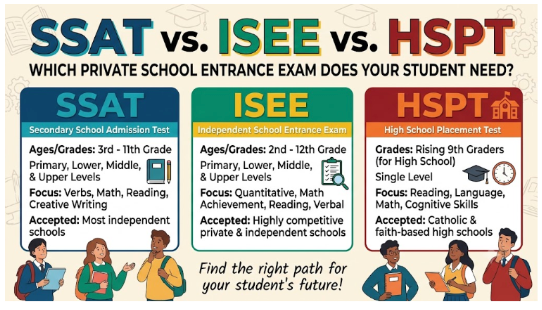
The SSAT, ISEE, and HSPT are three well-known exams used by private and independent schools to assess students as part of the admissions process. Although they share the goal of measuring academic skills, they differ in their grade levels, test sections, question formats, timing, and scoring.
Understanding these differences is an important first step for parents, teachers, and students beginning the private school admissions process.
The most important thing to remember is that schools determine which entrance exams they accept or require. Therefore, families should always check the admissions requirements of each school before deciding which exam to take.
This guide explains what the SSAT, ISEE, and HSPT are, who typically takes each exam, how they differ, and how parents and teachers can help students determine which test is appropriate.
What Are the SSAT, ISEE, and HSPT?
SSAT: Secondary School Admission Test
The Secondary School Admission Test (SSAT) is an admissions test used by many independent, private, and boarding schools.
The SSAT is offered at different levels based on the student’s grade. The three primary levels are:
- Elementary Level – for younger students
- Middle Level – generally for students applying to middle grades
- Upper Level – generally for students applying to high school and beyond
The SSAT evaluates skills in areas such as verbal reasoning, reading comprehension, and quantitative reasoning. Depending on the level, the test also includes a writing sample.
Because the SSAT is used by schools with different admissions requirements, students and families should check the specific requirements of their target schools.
ISEE: Independent School Entrance Exam
The Independent School Entrance Exam (ISEE) is an admissions assessment developed by Educational Records Bureau (ERB) and used by many independent schools.
The ISEE has four levels:
- Primary Level – for younger students
- Lower Level – generally for students entering Grades 5–6
- Middle Level – generally for students entering Grades 7–8
- Upper Level – generally for students entering Grades 9–12
The ISEE assesses verbal reasoning, quantitative reasoning, reading comprehension, and mathematics achievement. It also includes an unscored essay that can be provided to schools.
The ISEE is therefore used across a relatively broad range of grade levels, from elementary through high school admission.
HSPT: High School Placement Test
The High School Placement Test (HSPT) is commonly used by Catholic and other parochial high schools as part of the high school admissions and placement process.
Unlike the SSAT and ISEE, the HSPT is primarily associated with students entering ninth grade.
The HSPT assesses five major areas:
- Verbal Skills
- Quantitative Skills
- Reading Comprehension
- Mathematics
- Language
The test is known for its relatively fast pace, requiring students to answer a large number of questions within a limited amount of time.
SSAT vs. ISEE vs. HSPT: Key Differences
While all three exams assess academic readiness, their structures are different.
| Feature | SSAT | ISEE | HSPT |
| Full name | Secondary School Admission Test | Independent School Entrance Exam | High School Placement Test |
| Commonly used by | Independent, private, and boarding schools | Independent schools | Catholic and parochial high schools |
| Grade levels | Elementary, Middle, Upper | Primary, Lower, Middle, Upper | Primarily students entering Grade 9 |
| Main academic areas | Verbal, Reading, Quantitative | Verbal Reasoning, Quantitative Reasoning, Reading, Mathematics | Verbal, Quantitative, Reading, Mathematics, Language |
| Writing component | Writing sample | Essay/writing sample | No essay component |
| Guessing penalty | Yes at Middle and Upper Levels | No | No |
| Pacing | Timed | Timed | Particularly fast-paced |
| Testing schedule | Multiple opportunities may be available | Testing seasons | Often scheduled around individual school admissions |
The biggest differences are not simply the subjects tested. The level of the exam, question style, pacing, and scoring system can create a very different testing experience for students.
Understanding the SSAT
The SSAT is designed to measure skills that can help schools evaluate a student’s academic readiness for independent school education.
For Middle and Upper Level students, the exam focuses on Verbal, Quantitative, and Reading skills and includes a writing sample.
SSAT Verbal
The Verbal section focuses heavily on vocabulary and relationships between words.
Students may encounter:
- Synonyms
- Analogies
- Vocabulary questions
- Verbal relationships
Building a strong vocabulary and understanding how words relate to one another are important skills for this section.
SSAT Quantitative
The Quantitative section measures mathematical reasoning.
Rather than focusing only on memorized formulas, questions require students to apply mathematical concepts and reason through problems.
Students may need to identify relationships, recognize patterns, and determine efficient ways to solve quantitative problems.
SSAT Reading
The Reading section measures a student’s ability to understand and analyze written passages.
Questions may require students to identify:
- Main ideas
- Supporting details
- Inferences
- Author’s purpose
- Information presented in the passage
Students need both reading comprehension and the ability to work within the time limit.
SSAT Writing Sample
The SSAT includes a writing sample that is not part of the scored SSAT result.
The writing sample can nevertheless be an important part of the admissions process because it may be sent to schools along with the student’s application materials.
SSAT Guessing Penalty
One feature that distinguishes the SSAT from the ISEE and HSPT is its scoring approach.
At the Middle and Upper Levels, incorrect answers receive a ¼-point deduction.
Students therefore need to understand the scoring system and how it affects their approach to questions.
Understanding the ISEE
The ISEE is designed to assess both reasoning abilities and academic achievement.
For the Lower, Middle, and Upper Levels, the main scored sections are:
- Verbal Reasoning
- Quantitative Reasoning
- Reading Comprehension
- Mathematics Achievement
The exam also includes an essay.
ISEE Verbal Reasoning
The Verbal Reasoning section assesses vocabulary and verbal reasoning.
Students encounter question types such as:
- Synonyms
- Sentence completion
- Vocabulary-based reasoning
Understanding vocabulary in context can be particularly useful when answering these questions.
ISEE Quantitative Reasoning
Quantitative Reasoning measures how students use mathematical concepts to reason through problems.
Students may need to compare quantities, identify relationships, and determine how numerical information can be used to solve a problem.
ISEE Reading Comprehension
The Reading Comprehension section asks students to read passages and answer questions based on what they have read.
Questions can involve:
- Main ideas
- Supporting details
- Inference
- Vocabulary
- Organization
- Logical relationships
ISEE Mathematics Achievement
The Mathematics Achievement section focuses more directly on mathematical knowledge and skills.
This creates an interesting distinction within the ISEE: Quantitative Reasoning focuses on mathematical reasoning, while Mathematics Achievement focuses more directly on mathematics skills and knowledge.
ISEE Essay
The ISEE includes an essay that is not included in the student’s scored ISEE results.
The essay is provided to schools and may be considered as part of the overall admissions process.
No Guessing Penalty
Unlike the SSAT, the ISEE does not deduct points for incorrect answers.
This is an important difference for students and families to understand when comparing the two exams.
Understanding the HSPT
The HSPT is primarily associated with admission to Catholic and parochial high schools and is generally taken by students applying for ninth-grade admission.
The exam includes five major areas.
Verbal Skills
The Verbal section measures students’ understanding and use of language and verbal concepts.
Vocabulary and verbal relationships are important components.
Quantitative Skills
The Quantitative section assesses numerical reasoning and the ability to work with mathematical relationships.
Reading Comprehension
Students read passages and answer questions that assess their understanding of the material.
As with the SSAT and ISEE, students need to understand the passage while working within a fixed time limit.
Mathematics
The Mathematics section measures students’ knowledge and application of mathematical concepts.
Language
The Language section focuses on written language skills, including areas such as grammar, usage, and sentence structure.
HSPT Pacing
One of the defining characteristics of the HSPT is its fast pace.
The original structure described in the source article includes approximately 298 multiple-choice questions in about 150 minutes.
This means students need to manage their time carefully while maintaining accuracy.
For students and parents comparing entrance exams, pacing is therefore an important factor to understand.
SSAT vs. ISEE vs. HSPT: What Should Families Consider?
Once parents understand the basic differences among the three exams, the next question is how to determine which exam their student should take.
There is no single test that every private school requires. The appropriate exam depends first on the schools the student is applying to.
Parents and teachers can consider several factors.
1. Start With the School’s Admission Requirements
This should always be the first step.
Make a list of the schools the student is considering and check:
- Which entrance exams does the school accept?
- Is a particular exam required?
- Which test level applies to the student?
- What are the testing deadlines?
- Does the school have any additional testing requirements?
Do not assume that because one private school accepts the SSAT, another school will accept it as well.
- Consider the Student’s Grade Level
Grade level is another important consideration.
A younger student may be looking at the ISEE Primary or Lower Level or an SSAT Elementary Level assessment.
A student applying to middle school may encounter the SSAT Middle Level or ISEE Middle Level.
A student applying to high school may encounter the SSAT Upper Level, ISEE Upper Level, or HSPT, depending on the schools being considered.
Understanding the appropriate level is essential before beginning preparation.
3. Understand the Different Test Formats
Parents and teachers should familiarize themselves with the types of questions students will encounter.
For example:
- The SSAT places considerable emphasis on vocabulary, verbal relationships, reading, and quantitative reasoning.
- The ISEE separates verbal and quantitative reasoning from mathematics achievement.
- The HSPT includes five academic areas and requires students to work at a particularly fast pace.
Understanding these differences allows families to have a more informed conversation with the student about the test.
4. Consider the Student’s Academic Strengths
If a school accepts more than one entrance exam, parents and teachers can consider the student’s existing academic strengths.
Questions to consider include:
- Is the student comfortable with vocabulary and verbal reasoning?
- How strong are the student’s mathematics skills?
- How well does the student understand reading passages?
- Is the student comfortable working under strict time limits?
- Does the student tend to work carefully or quickly?
- How does the student respond to different types of questions?
These questions do not determine which test a student must take, but they can help families understand how the student may experience each exam.
5. Give the Student an Opportunity to Learn About the Exam
Students can benefit from becoming familiar with the exam before making a decision.
Parents and teachers can introduce students to:
- Sample questions
- Official practice materials
- Section formats
- Timing requirements
- Scoring rules
- Writing requirements
The purpose is not necessarily to determine which exam is “easier.” Instead, it helps students understand what each test expects and where they may need to become familiar with a particular format.
How Parents and Teachers Can Help Students Decide
Choosing a private school entrance exam should be a collaborative decision involving the student, parents, teachers, and, when appropriate, the school or admissions office.
Parents and teachers can help by following a few simple steps.
First, identify the target schools.
Determine which exams each school accepts or requires.
Next, identify the appropriate test level.
The student’s grade and the grade they are applying to will determine which SSAT or ISEE level applies.
Then, compare the test formats.
Look at the sections, question types, timing, writing requirements, and scoring rules.
Finally, consider the student’s individual strengths and preferences.
A student who is comfortable with a particular type of question or testing format may feel more confident when working with that format.
Most importantly, parents and teachers should avoid choosing an exam simply because someone says it is “easier.” The better approach is to understand the school’s requirements and the student’s academic profile, then make an informed decision.
Final Thoughts
The SSAT, ISEE, and HSPT are all important exams in the private school admissions landscape, but they serve somewhat different purposes and are used by different groups of schools.
The SSAT is commonly associated with independent, private, and boarding schools and includes verbal, reading, and quantitative reasoning.
The ISEE is used by many independent schools and includes verbal reasoning, quantitative reasoning, reading comprehension, and mathematics achievement.
The HSPT is commonly used by Catholic and parochial high schools for students entering ninth grade and covers verbal, quantitative, reading, mathematics, and language skills.
For families beginning the private school admissions process, the best place to start is simple:
Find out what each target school requires or accepts.
Once that is clear, parents and teachers can help students understand the available exams, compare their formats, and consider which test aligns with the student’s grade level, academic strengths, and the schools they hope to attend.
Knowing the differences between the SSAT vs. ISEE vs. HSPT can make the private school admissions process less confusing and help students approach their entrance exam with a clearer understanding of what to expect.