
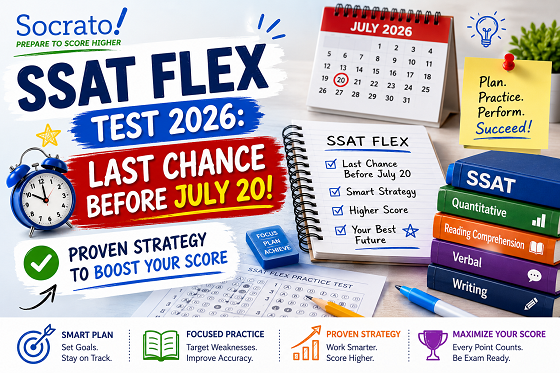
SSAT Flex Test 2026: Last Chance Before July 20 + Proven Strategy to Boost Your Score
If you’re applying to competitive private schools, your SSAT (Secondary School Admission Test) score can significantly influence admissions decisions. But many families miss standard testing windows and assume they’ve lost their chance.
Not true.
The SSAT Flex Test 2026 is your final opportunity this testing year—with a hard deadline of July 20, 2026—to improve your score, strengthen a waitlist application, or get ahead for next year.
This guide covers everything you need, including advanced test-taking strategies, preparation timelines, and how to use data-driven diagnostics to maximize results.
What Is the SSAT Flex Test?
The SSAT Flex Test is a paper-based SSAT taken on a flexible date instead of fixed national test dates.
Key Rules:
- One Flex test per year (Aug 1 – July 20)
- Paper-based only
- Must be scheduled through an approved school or consultant
- Final deadline: July 20, 2026
Flex tests are often administered in smaller, quieter settings, which can help reduce anxiety and improve performance.
Why Take the SSAT Flex Test Now?
1. Improve Waitlist Outcomes
A higher SSAT score submitted in late spring or early summer can meaningfully impact admissions decisions.
2. Better Testing Environment
Smaller groups = less stress = better focus and accuracy.
3. Early Benchmark Advantage
Taking the test now gives you a baseline score and time to improve before the next admissions cycle.
How to Register for an SSAT Flex Test
- Find an authorized SSAT consultant or school
- Get your unique access code
- Register via your SSAT account
Expect an additional proctoring fee beyond standard registration.
The High-Performance SSAT Strategy (4–6 Weeks Plan)
Phase 1: Diagnostic-First Approach (4–6 Weeks Out)
Start with a full-length official SSAT practice test.
But don’t stop at the score.
Top-performing students use advanced diagnostics to understand:
- Section-level weaknesses
- Time management gaps
- Accuracy vs. guessing patterns
- Percentile positioning
Using tools like Socrato’s SSAT Diagnostic Report, you can break down performance at a granular level. Combined with official SSAT practice test bubble sheet processing, this creates a realistic test simulation with actionable insights.
This is where most score improvement actually happens.
Phase 2: Targeted Skill Building (2–4 Weeks Out)
Focus on high-yield areas:
- Verbal: Synonyms, analogies, vocabulary patterns
- Quant: Algebra, ratios, word problems
- Reading: Inference, tone, main idea
At this stage, preparation should be data-driven, not generic.
Advanced SSAT Test-Taking Strategy (Score Maximization Section)
This is where strong students separate themselves.
1. Understand the SSAT Scoring System
- +1 point for correct answers
- ?0.25 points for incorrect answers
- 0 points for skipped questions
Implication: Blind guessing hurts your score.
2. The “Educated Guess” Framework
Use this decision model during the test:
- 0 eliminations ? Skip
- 1 elimination ? Usually skip
- 2+ eliminations ? Guess strategically
This balances risk vs reward and protects your raw score.
3. Time Management Architecture
Each section is designed to pressure your pacing.
Best practice:
- First pass ? Answer what’s clear and fast
- Second pass ? Return to medium difficulty questions
- Final pass ? Make calculated guesses (not random)
Students who mismanage time often:
- Rush the last 20% of the test
- Make low-quality guesses
- Lose scaled score unnecessarily
4. Section-Specific Tactics
Verbal (Highest Leverage Section)
- Pre-think synonyms before looking at options
- Break analogies into relationships (cause-effect, part-whole, etc.)
- Build a personal vocabulary bank
Quantitative
- Don’t overcompute—look for shortcuts
- Estimate when possible
- Flag time-consuming questions early
Reading
- Focus on main idea first, then details
- Avoid re-reading entire passages
- Watch for trap answers that are “almost correct”
5. Error Pattern Recognition (Game-Changer)
Most students repeat the same mistakes:
- Misreading questions
- Rushing easy problems
- Overthinking medium questions
With Socrato’s SSAT diagnostic reports, you can identify:
- Exact question types you miss
- Timing inefficiencies
- Accuracy trends across sections
This allows for precision improvement, not guesswork.
Phase 3: Final Week Optimization
- Review vocabulary and key formulas
- Practice timed sections (not full tests)
- Analyze last mistakes deeply
- Simulate one real test environment
SSAT Flex vs Standard Test
| Feature | Standard SSAT | Flex SSAT |
| Dates | Fixed (Oct–April) | Flexible |
| Location | Test centers | Schools/consultants |
| Attempts | Up to 6/year | Once/year |
| Format | Paper | Paper |
| Deadline | April 12, 2026 | July 20, 2026 |
Common Mistakes to Avoid
- Ignoring negative marking strategy
- Practicing without detailed analysis
- Poor pacing management
- Over-relying on full-length tests instead of targeted prep
- Not using realistic test simulations
Final Thoughts: Turn the Flex Test Into an Advantage
The SSAT Flex Test is not just a backup—it’s a strategic opportunity.
Students who combine:
- Realistic practice testing
- Smart test-taking strategies
- Deep diagnostic insights
…consistently outperform those who rely on basic prep.
Next Step: Upgrade Your SSAT Preparation
To maximize your SSAT score before July 20:
- Take the Official SSAT Practice Test.
- Get a detailed SSAT diagnostic report
- Track section-wise improvement
- Apply data-driven strategy adjustments
- Process the bubble sheet using an online data extraction tool.
These tools bridge the gap between practice and performance—where real score gains happen. Download Socrato free ebook to learn the SSAT Smart prep strategy.