
SAT Test Day Tips: Your Last 72 Hours Study Plan
The SAT is this Saturday, November 7. If you are reading this on Wednesday, you have roughly 72 hours left. That is not enough time to learn a whole new skill set, but it is plenty of time to sharpen what you already know, protect your energy, and walk into the test calm and prepared.
This guide shares practical SAT test day tips: a simple three-day plan, a test-day checklist, and the pacing strategies that matter most on the digital SAT.
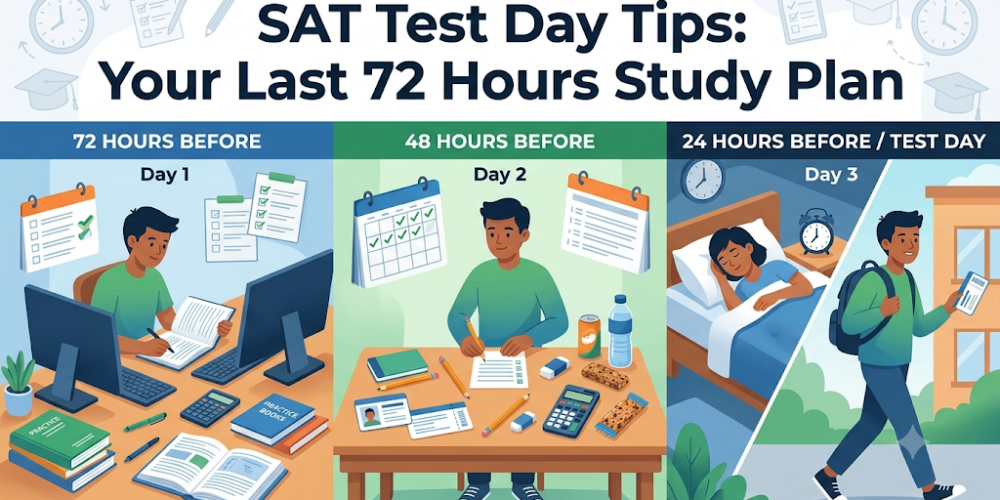
Quick answer: In the last 72 hours, do targeted practice on day one, light review on day two, and rest on day three. Pack your ID and admission ticket, charge your device, sleep well, and answer every question on test day.
What to Review in the Last 72 Hours (and What Not to Cram)
The biggest mistake students make in the final days is trying to learn everything at once. Cramming new topics raises stress and rarely sticks. Instead, focus on high-yield skills you already partly know.
Review these:
- Reading and Writing: Standard English conventions (punctuation, subject-verb agreement, pronoun clarity, verb tense), transitions, and words-in-context questions. These are fast, rule-based points.
- Math: Linear equations and systems, percentages and ratios, basic geometry formulas, quadratics, and interpreting graphs and tables.
- Your own error log: The questions you keep missing are your best study material.
Skip these:
- Brand-new, advanced topics you have never practiced
- Marathon study sessions late at night
- Switching to a new prep book or strategy now
Think of the final 72 hours as tuning an instrument, not building one.
Your 3-Day SAT Study Plan
Day 1 (Wednesday): Targeted Practice
This is your last real work day. Aim for 60 to 90 minutes, not a full day.
- Take one timed section or module of practice, in a quiet place, with the same device you will use on test day.
- Review every miss. For each one, write down why you missed it: content gap, careless error, or ran out of time.
- Pick your top two or three recurring mistakes and do a short set of practice questions on each.
Tip: Sort your mistakes into “knew it but slipped” and “did not know it.” The first group is easy points to recover this week.
Day 2 (Thursday): Light Review
Keep it short, about 30 to 45 minutes.
- Re-read your error log and formula notes.
- Do a handful of warm-up questions in your weakest area to stay sharp.
- Practice your pacing: for each question, decide in advance when you will mark it and move on.
- Set up your testing device (see the checklist below), and download or update any required testing app now, not Saturday morning.
- Start gathering your test-day items tonight.
Stop early. You are protecting your brain, not exhausting it.
Day 3 (Friday): Rest and Reset
The day before the test is for recovery, not a full practice test.
- Do no more than 15 to 20 minutes of light review, or skip studying altogether.
- Eat balanced meals and stay hydrated.
- Do something you enjoy: a walk, a workout, music, time with friends or family.
- Confirm your test center location, route, and arrival time.
- Get to bed early. Consistent sleep across the last few nights matters more than one perfect night.
Should I take a full practice test the day before? No. A full-length test is draining, and a bad result can shake your confidence at the worst moment. Do your last full practice test earlier in the week or before it.
SAT Test-Day Checklist: What to Bring
Prepare this on Friday so Saturday morning is calm.
- Admission ticket (printed or saved on your phone, per College Board instructions)
- Acceptable photo ID that meets College Board requirements
- Fully charged testing device and charger, with the required testing app installed and tested
- Approved calculator (a built-in graphing calculator is available in the test app, but many students like a familiar backup) and extra batteries if applicable
- Pencils and a watch, if your test center allows them
- Water and a snack for the break
- Layers of clothing, since test rooms can run hot or cold
- Directions and arrival time, with a buffer for traffic and parking
Always double-check the latest rules on the official College Board site for what is and is not allowed. Policies can change, and your test center’s instructions come first.
SAT Pacing and Guessing Strategy
On the digital SAT, a few habits can protect your score.
- There is no penalty for wrong answers. Never leave a question blank. If time is running out, make your best guess.
- Do not get stuck. If a question is taking more than about a minute or two, mark it, choose a best guess, and move on. You can come back if time allows.
- Use elimination. Even removing one answer choice improves your odds.
- The test is adaptive. Your performance in the first module of each section shapes the difficulty of the second module, so give the first module your full, careful attention.
- Use the built-in tools. The on-screen calculator, annotation, and flagging features are there to help. Practice with them beforehand.
- Read the question first in short passages. Knowing what you are looking for makes reading faster and more focused.
Managing Nerves on Test Day
Some nerves are normal and can even sharpen focus. Try these simple resets:
- Breathe: Inhale for four counts, hold for four, exhale for six. Repeat three times.
- One question at a time: You do not need to think about your final score. Just answer the question in front of you.
- Let go of the last question: If you think one went badly, move on. Everyone misses questions.
- Eat and drink at the break: A snack and water help keep your energy steady.
After the Test: Retake the SAT, or Switch to the ACT?
Once the SAT is behind you, the next question is whether to retake it or try something different. With SAT and ACT dates coming up in December, now is a great time to find out which test is a better fit for your strengths.
The SAT and ACT reward different skills. The SAT gives you more time per question and leans toward reasoning in context, while the ACT moves faster and includes a Science section that tests data interpretation. Many students score noticeably higher on one than the other without realizing it.
Not sure which test to take next? Try the Socrato SAT vs. ACT Predictor. It compares your likely performance on each test so you can decide where to focus your December prep. Read our full guide, SAT vs. ACT: Which Test Is Better for You?, to see how the two tests compare.
Frequently Asked Questions
What should I do the night before the SAT?
Pack your bag, confirm your route and arrival time, eat a balanced dinner, and go to bed early. Avoid late-night studying or screens right before sleep.
Is it okay to study the morning of the SAT?
A quick five-minute look at your formula sheet or error log is fine, but avoid anything new. Focus on eating breakfast, staying calm, and arriving early.
How many hours should I study in the last three days?
About 60 to 90 minutes on Wednesday, 30 to 45 minutes on Thursday, and little to none on Friday. Quality and rest beat quantity now.
Is there a penalty for guessing on the SAT?
No. Answer every question, even if you have to guess.
What if I do not feel ready?
Most students feel less ready than they are. Focus on the strategies you can control: pacing, elimination, and staying calm. If you are still unhappy with your score afterward, you can retake the SAT or explore the ACT with the Socrato predictor.
Can Socrato help me get ready for the next test?
Yes. Socrato offers practice, skill-level analytics, and the SAT vs. ACT Predictor to help you plan your next step. Tutors and schools running paper practice tests can also use Socrato’s bubble sheet processing to get fast, detailed results.
Final Thoughts
Your preparation is already done. These last 72 hours are about confidence, rhythm, and rest. Review smart, sleep well, show up early, and trust your work.
Good luck on Saturday. And when you are ready to plan your next step, take the Socrato SAT vs. ACT Predictor and see which test could give you your best score.