
The August 22 SAT Is Close. Volume of Practice Test Won’t Save You — Diagnosis Report Will.
With the August 22 SAT just a few weeks away, the pressure is officially on. If you are like most students, your first instinct is probably to panic-print every practice test you can find and burn through them back-to-back.
It feels productive. It feels like hard work. But at this stage in the game, it is the biggest mistake you can make.
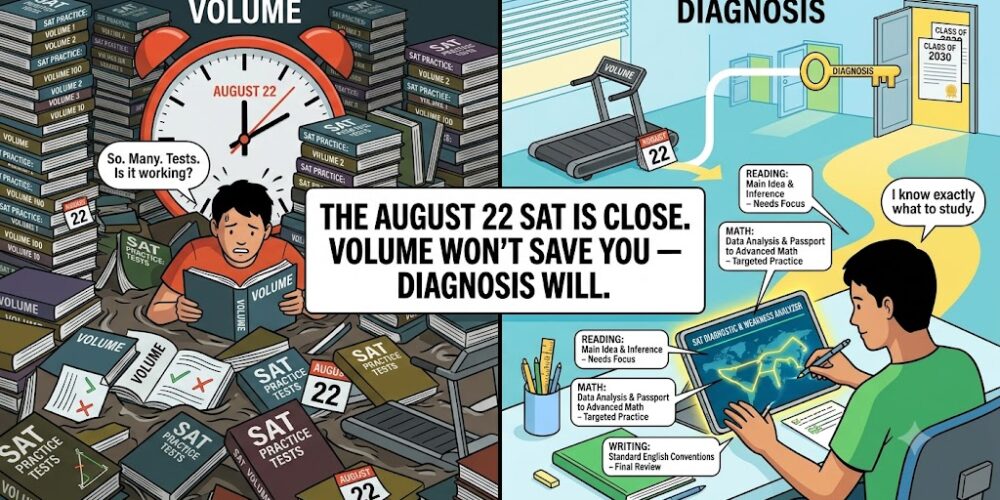
When time is short, volume won’t save you. Diagnosis will.
Here is why blindly grinding through practice questions is a trap, and how shifting your focus to targeted diagnosis can actually move your score before test day.
Why Students Stop Improving Before Test Day
The students often plateau because they:
- repeat the same mistakes
- don’t review
- don’t know weak skills
- don’t understand timing
The “Volume Trap”
There is a common misconception in test prep that taking more practice tests automatically equals a higher score. We call this the Volume Trap.
If you take a practice test, score a 1250, and immediately jump into the next practice test without breaking down your performance, you aren’t actually improving. You are just building stamina for your mistakes. You are training your brain to repeat the exact same errors, cementing bad habits just in time for the real exam.
At this point in August, you don’t have the time to learn by osmosis. You need surgical precision.
Why SAT Diagnostic Review Leads to Better Scores
Diagnosis is the process of relentlessly interrogating your mistakes. Instead of caring about the final score on a practice test, a diagnostician cares only about the why behind every incorrect answer.
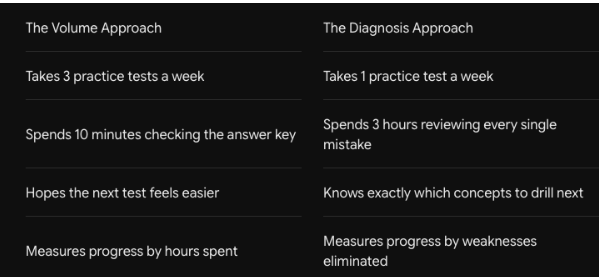
Here is how the two approaches compare:
What Should a Good SAT Diagnostic Report Show?
A good detail SAT diagnostic Report should include:
? Math domains
? Reading & Writing domains
? Question types
? Timing
? Accuracy
? Guess patterns
? Weak concepts
Difficulty level
How to Diagnose Your Mistakes (The 3-Step Process)
To make the most of the next few weeks, you need to transition from test-taker to test-analyzer. Follow these three steps after every practice session:
1. Categorize Every Error
Not all mistakes are created equal. When you miss a question, force yourself to drop it into one of these four buckets:
- Content Gap: “I genuinely do not know the grammar rule or math formula required to solve this.” (Action: Go back to the textbook or video lesson).
- Comprehension: “I misread the passage or misunderstood what the question was asking.” (Action: Slow down your reading pace; practice annotating).
- Execution/Careless Error: “I knew how to do this, but I dropped a negative sign or bubbled the wrong letter.” (Action: Write out your steps more clearly).
- Timing: “I panicked because I had 30 seconds left.” (Action: Practice skipping time-sink questions earlier in the section).
2. Review the “Lucky” Guesses
A guessed right answer is just a wrong answer in disguise. If you were down to two choices and guessed correctly, mark it for review anyway. If you don’t know exactly why the other three answers are mathematically or logically false, you haven’t mastered the question.
3. Keep an Error Log
Create a spreadsheet or grab a dedicated notebook. For every missed question, write down:
- The question type/concept.
- Why did you get it wrong?
- The exact step-by-step process to get it right next time.
Before you take your next practice test, read through this entire log. You will be shocked at how quickly you spot the traps you usually fall for.
Your Action Plan for SAT August 22
You have a little over two weeks. Here is how to structure your final push:
- Take fewer tests: Limit yourself to one full-length, timed practice test per week.
- Triple your review time: If a test takes three hours to complete, set aside at least three hours to review it over the following days.
- Targeted drills only: Stop doing generalized practice. If your error log shows you are struggling with Heart of Algebra or Command of Evidence, spend your week doing only those specific drills.
Practice Resources for the Digital SAT
As you prepare for the August 22 Digital SAT, make sure you’re using a good quality practice test.
The College Board Bluebook™ application offers official adaptive Digital SAT practice tests that closely simulate the actual testing experience. These tests are one of the ways to become familiar with the exam’s format, timing, and adaptive structure. In addition to Bluebook, official College Board paper-based SAT practice tests (non-adaptive) remain valuable resources. Although these practice tests are not adaptive like the Digital SAT, they contain authentic SAT questions that help students strengthen content knowledge, reinforce concepts, and gain additional practice in Reading, Writing, and Math.
The most effective preparation strategy is not choosing one resource over another—it is using both strategically while carefully reviewing every completed practice test. So that the official practice test is enough for your prep test.
Why Practice Test Diagnostic Reports Matter More Than Number of Practice Test
Official practice tests provide an excellent benchmark, but a score alone doesn’t explain why you earned that score.
For meaningful improvement, students need answers to questions such as:
- Which Math concepts are consistently causing mistakes?
- Which Reading & Writing skills need additional practice?
- Am I losing points because of content knowledge or poor time management?
- Which question types should I prioritize before test day?
This is where detailed diagnostic reports become valuable.
While the standard Bluebook score report provides an overall performance summary, many students and tutors benefit from more detailed analytics that highlight patterns, recurring mistakes, timing trends, and topic-level strengths and weaknesses.
Several educational platforms provide this type of analysis.
For example, Socrato enables students, tutors, and academies to generate comprehensive diagnostic reports for both official Bluebook Digital SAT practice tests and official College Board paper-based SAT practice tests. These reports provide detailed performance analysis that helps students spend their remaining study time on the concepts that are most likely to improve their scores.
Remember, a practice test is only valuable if it changes what you study next.
Final Thoughts
The Digital SAT doesn’t reward students simply for completing the greatest number of practice tests. It rewards students who understand their mistakes, strengthen their weak areas, and apply those lessons on test day.
As the August 22 SAT approaches, shift your focus from quantity to quality. Instead of asking, “How many more practice tests should I take?” ask yourself, “What did I learn from my last practice test?”
Every missed question is an opportunity to improve. Every diagnostic report is a roadmap that helps you study with greater purpose and confidence.
So, take a breath, put away the stack of unused practice tests, open your error log, and let every practice session guide your next step. Study smarter, review deeper, and walk into test day knowing your preparation was driven by insight—not guesswork..