
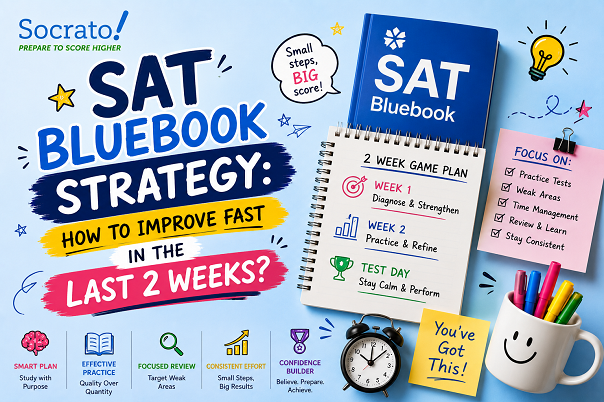
SAT Bluebook Strategy: How to Improve Fast in the Last 2 Weeks?
If you’re two weeks away from your SAT, you don’t need more content—you need precision. The fastest score gains now come from how you practice, not how much you practice.
The College Board’s official Bluebook app gives you the most realistic SAT experience, with 10 full-length adaptive practice tests. But here’s the catch: most students use it inefficiently.
This guide breaks down a high-impact 14-day strategy using Bluebook—and shows how layering in diagnostic insights from Socrato can accelerate improvement for students, parents, and tutors.
The Core Problem: Practice Without Insight
College board Bluebook tests are excellent simulations, but the score report is minimal:
- You get section scores
- A general performance band
- Limited breakdown of strengths/weaknesses
What’s missing:
- Skill-level gaps (e.g., “Command of Evidence vs Transitions”)
- Error patterns (careless vs conceptual vs timing)
- Difficulty analysis (easy vs medium vs hard misses)
- Hard versus easy Module identification.
That’s why many students plateau—even after taking multiple tests.
The 14-Day High-Impact Strategy
Phase 1 (Days 1–3): Establish Your Baseline
Take 1 full Bluebook test under real conditions.
Do not pause. Do not redo questions.
After the test:
- Note total score + section scores
- Identify where you lost points (Reading/Writing vs Math)
? At this stage, resist guessing your weaknesses. Most students misdiagnose.
Phase 2 (Days 4–7): Deep Analysis (This Is Where Scores Jump)
This is the most important phase—and where most students fail.
Instead of just reviewing wrong answers, you need structured diagnostics.
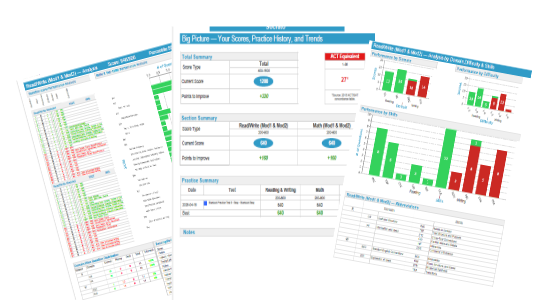
For example, a detailed diagnostic (like the one generated by Socrato from a Bluebook test) breaks performance into:
- (Reading & Writing)Domains:
- Craft & Structure
- Information & Ideas
- Standard English Conventions
- Expression of Ideas
- Math Domains:
- Algebra
- Advanced Math
- Problem Solving & Data
- Geometry & Trigonometry
- Question-Level Insights:
- Difficulty (Easy / Medium / Hard)
- Skill (e.g., Transitions, Textual Evidence, Quadratics)
- Accuracy %
This type of Report shows perfect clarity:
- 100% accuracy across all domains ? mastery
- In real scenarios ? pinpoint gaps like:
- Weak in Command of Evidence
- Struggles with nonlinear functions
- Errors concentrated in hard questions only
? This is exactly where Socrato becomes powerful:
It converts raw Bluebook results into actionable learning signals, not just scores.
Phase 3 (Days 8–11): Targeted Skill Drilling
Now you stop “taking tests” and start fixing specific weaknesses.
Reading & Writing Strategy
Focus on:
- Command of Evidence ? practice paired questions
- Transitions & Rhetorical Synthesis ? quick wins
- Timing discipline ? ~60–70 seconds per question
Math Strategy
Prioritize:
- High-frequency topics:
- Linear equations
- Quadratics
- Functions
- Then move to:
- Word problems (rates, percentages)
- Geometry/trig only if weak
? Use this rule:
- If you got it wrong ? learn concept
- If you got it right but slow ? optimize method
- If you guessed ? treat as wrong
Phase 4 (Days 12–14): Simulation + Fine-Tuning
Take 2 more Bluebook tests (Test 8–10 ideally).
After each test:
- Compare score trends
- Check if previous weak areas improved
- Identify remaining error clusters
At this point:
- You’re not learning new concepts
- You’re refining execution
The Score-Boosting Insight Most Students Miss
Not all mistakes are equal.
A good diagnostic separates:
- Knowledge gaps ? require content review
- Execution errors ? require practice patterns
- Timing issues ? require pacing strategy
For example, in your sample report:
- 800/800 with 100% accuracy across domains
- Balanced performance across difficulty levels
That’s what optimized performance looks like:
- No weak domains
- No timing leakage
- No careless mistakes
Most students aren’t far from this—they just lack visibility.
How Parents and Tutors Should Approach This
For Parents
- Don’t ask: “How many tests did you take?”
- Ask: “What exactly are you improving?”
Look for:
- Skill-level progress
- Reduction in repeated mistakes
- Consistency across tests
For Tutors & Tutoring Companies
Stop generic prep. Move to data-driven instruction:
- Identify their strengths and areas of improvement.
- Analyze the batch/group performance.
- Create the group/class/batch by their Domain performance.
Instead of:
- “Let’s practice Reading today”
Do:
- “We’re fixing Command of Evidence at Level 3 difficulty”
Tools like Socrato enable:
- Batch student diagnostics
- Domain Analysis
- Skill-gap grouping
- Difficulty level analysis individual/class analysis.
This is how you scale results across multiple students.
Common Mistakes in the Last 2 Weeks
Avoid these:
- ? Taking 5+ full tests without review
- ? Studying random topics instead of weak areas
- ? Ignoring timing strategy
- ? Over-relying on passive reading (videos, notes)
Final 2-Week Checklist
- ? 3–4 full Bluebook tests max
- ? Deep diagnostic after each test
- ? Focus on 2–3 highest-impact weak areas
- ? Daily timed practice (not untimed)
- ? Review every mistake
Bottom Line
The Bluebook app gives you real SAT exposure.
But exposure alone doesn’t improve scores.
Improvement comes from:
- Precision diagnostics
- Targeted practice
- Feedback loops
That’s where combining Bluebook with tools like Socrato creates a measurable edge.
In the last 2 weeks, your goal isn’t to work harder—it’s to work surgically.