

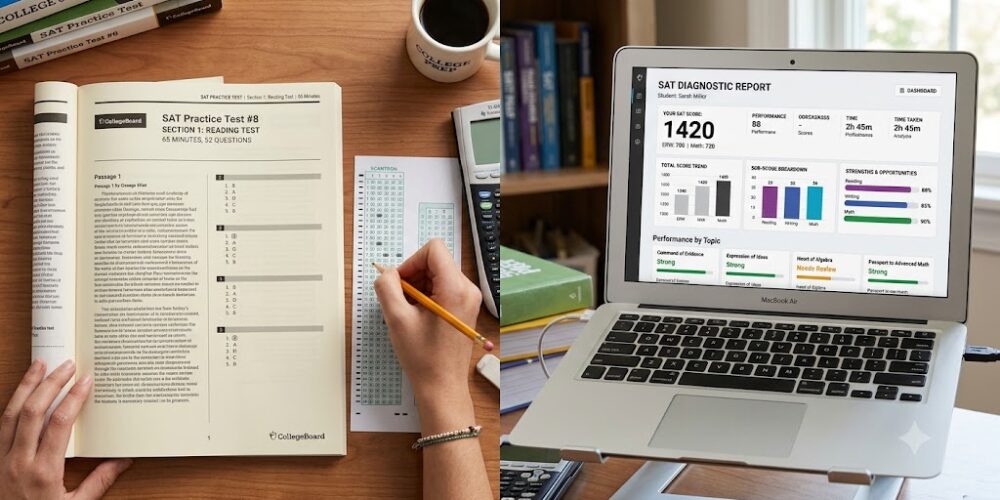
The August 22 SAT Is Close. Volume Won’t Save You — Diagnosis Will.
There is a version of SAT prep that feels productive and isn’t: grinding through practice test after practice test, watching the composite score wobble between 1290 and 1320, and concluding that you simply need to do more.
More is rarely the answer this late. Precision is.
With the August 2026 SAT administered globally on Saturday, August 22, most students have roughly three weeks of usable study time left. Three weeks is not enough to relearn algebra. It is more than enough to close four or five specific skill gaps — if you can identify them.
That identification is exactly what an SAT diagnostic report does. And most students never actually read theirs.
August 2026 SAT: Key Dates at a Glance
| Milestone | Date |
| Test date | Saturday, August 22, 2026 (7:45 a.m. local reporting time) |
| Regular registration deadline | August 7, 2026 (11:59 p.m. ET) |
| Late registration / change deadline | August 11, 2026 (additional fees may apply) |
| Score release date | September 4, 2026 |
| Next available dates | Sept 12 (deadline Aug 28) · Oct 3 (deadline Sept 18) · Nov 7 (deadline Oct 23) · Dec 5 (deadline Nov 20) |
Note for seniors and consultants: Because August 22 scores land on September 4, this administration functions as a genuine “first swing” for early-action applicants — with September 12 and October 3 still available as retakes before most November 1 deadlines. Treat August as diagnostic and scoreable, not as a dress rehearsal.
What an SAT Diagnostic Report Actually Is
When people say “diagnostic,” they often mean a single number: a baseline score. That’s the least useful part of the report.
A complete digital SAT diagnostic — the score report generated in My Practice after you finish a full-length Bluebook practice test — contains four distinct layers of information. Each answers a different question.
| Layer | What it shows | The question it answers |
| 1. Section and composite scores | Reading and Writing score, Math score, total (400–1600) | Where am I relative to my target? |
| 2. Content domain progress bars | A 7-bar proficiency indicator for each of the eight content domains | Which content areas are weakest? |
| 3. Question-level review | Every question, the answer you chose, the correct answer, and a full explanation | Why did I miss what I missed? |
| 4. Practice Specific Questions | An auto-generated, personalized question set built from your performance | What should I drill first? |
Students who only look at Layer 1 walk away with a score and no plan. Students who work Layers 2 through 4 walk away with a prioritized list. That difference is worth more points in three weeks than another six practice tests.
The Eight Content Domains You’ll Be Scored Against
Your progress bars map to eight domains — four per section. Knowing the skills nested inside each one is what turns “I’m bad at Reading” into something actionable.
Reading and Writing
| Domain | Approx. share of section | Skills tested |
| Information and Ideas | ~26% | Central Ideas and Details · Inferences · Command of Evidence |
| Craft and Structure | ~28% | Words in Context · Text Structure and Purpose · Cross-Text Connections |
| Expression of Ideas | ~20% | Rhetorical Synthesis · Transitions |
| Standard English Conventions | ~26% | Boundaries · Form, Structure, and Sense |
Math
| Domain | Approx. share of section | Skills tested |
| Algebra | ~35% | Linear equations and functions in one and two variables · Systems · Linear inequalities |
| Advanced Math | ~35% | Nonlinear functions and equations · Systems in two variables · Equivalent expressions |
| Problem-Solving and Data Analysis | ~15% | Ratios, rates, percentages · One- and two-variable data · Probability · Margin of error · Evaluating statistical claims |
| Geometry and Trigonometry | ~15% | Area and volume · Lines, angles, triangles · Right-triangle trig · Circles |
Percentages are approximate. Your own score report displays the exact percentage and an estimated question count directly above each domain’s progress bar — always use those numbers over generic ones.
How to Read the Progress Bars (Most Students Get This Wrong)
Each domain gets seven progress bars. The number filled in doesn’t represent “percent correct” — it represents the difficulty level at which you demonstrated proficiency. For the SAT specifically:
| Bars filled | Interpretation | What to do about it |
| 1–3 (Easy) | Foundational skills in this domain are still developing | Rebuild the concept. Khan Academy lessons, then easy-level Question Bank sets. Don’t jump to hard questions. |
| 4–5 (Medium) | Core skills are solid; complexity is the barrier | Drill medium and hard sets in the Student Question Bank. This is where points are cheapest. |
| 6–7 (Hard) | Approaching mastery | Fine-tune only. Light maintenance. Do not spend your remaining three weeks here. |
Two rules follow from this, and they’re where most study plans go sideways:
Rule 1 — Weight by frequency, not just by weakness. A 3-bar showing in Algebra (~35% of the Math section) is worth far more attention than a 3-bar in Geometry and Trigonometry (~15%). Same weakness, roughly double the scoring consequence. When two domains sit at the same level, always prioritize the one that appears more often on the test.
Rule 2 — The 4-to-5 band is the sweet spot. Moving a domain from 1 bar to 3 bars requires conceptual reconstruction — weeks of work. Moving from 4 to 6 requires exposure and pattern recognition — days of work. With three weeks left, hunt for medium-band domains first.
The Five-Question Diagnostic Audit
Take one full-length Bluebook practice test under real conditions — one sitting, timed, no phone, at a desk. Then sit down with the Score Details page and answer these five questions in writing. Budget 45–60 minutes. This audit is the single highest-leverage hour of prep available to you right now.
1. Which domains are in the medium band?
List every domain showing 4–5 bars. These are your primary targets. Rank them by the question-count estimate shown above each bar.
2. What type of error did I make on each miss?
This is the heart of the audit. Go question by question through your incorrect answers and tag each one. Every miss belongs to exactly one of four categories — and each demands a completely different response.
| Error type | How to recognize it | The fix | Time to fix |
| Content gap | You didn’t know the rule, formula, or concept. Reading the explanation teaches you something new. | Targeted relearning: Practice questions ? easy set ? medium set | 2–5 days per gap |
| Process error | You knew the content but chose the wrong approach, misread the question stem, or answered a question that wasn’t asked. | Build a checklist habit. Underline the actual asked questions before solving. | 3–7 days of deliberate practice |
| Timing error | You rushed it, guessed, or ran out of module time. Given 60 extra seconds you’d have gotten it. | Pacing drills, not content review. Practice flagging and returning. | 1–2 weeks of drilling |
| Careless error | You knew it, did it right, and still bubbled or transcribed wrong. Sign error, wrong variable, misread graph axis. | Verification routine on the final step. Reread the question before confirming. | Ongoing habit |
Here’s why this matters more than anything else in the report: a student with fifteen timing errors and a student with fifteen content gaps have identical scores and completely opposite study plans. Content review does nothing for the first student. Pacing drills do nothing for the second. Skipping this taxonomy is how three weeks evaporate.
3. Where in each module did my accuracy fall off?
Split each module in half and compare accuracy in the first half versus the second. A sharp drop-off in the back half signals stamina or pacing problems — not content problems. This is invisible in a domain breakdown and only appears when you look at question order.
4. Did the second module get harder or easier?
The digital SAT uses multistage adaptive testing: each section has two modules, and your performance on Module 1 determines whether Module 2 skews harder or easier. If your Module 2 was clearly the easier form, your ceiling is being set in Module 1 — which means early-module accuracy is your highest-value target, full stop.
5. What patterns repeat across my misses?
Look for the same skill tag appearing three or more times. Three missed Transitions questions is not bad luck; it’s a diagnosable, fixable, and genuinely quick win. Two weeks of Transitions drilling is unnecessary — two focused days usually closes it.
Turning the Audit Into a Three-Week Plan
Here is a defensible structure for the run-up to August 22. Adjust the specific domains to what your own audit produced; the architecture holds regardless.
| Phase | Dates | Focus | Daily commitment |
| Week 1 — Repair | Jul 30 – Aug 6 | Top two medium-band domains. Content relearning + easy/medium Question Bank sets. Confirm registration before the Aug 7 deadline. | 90 min |
| Week 2 — Integrate | Aug 7 – Aug 14 | Mixed-domain practice. Full timed modules (not full tests). Attack process and careless errors with verification routines. Take one full-length test on Aug 15. | 90–120 min |
| Week 3 — Sharpen | Aug 15 – Aug 20 | Re-audit the new report. Pacing drills. Review your error log, not new material. Light, high-confidence sets only. | 60 min |
| Taper | Aug 21 | No new content. Complete the Bluebook exam setup, print your admission ticket, pack your bag, and sleep. | 0 min |
Three principles hold this together:
Take fewer full-length tests than you think. Two more between now and test day is plenty — one around August 15, and that’s likely it. Full tests measure; they don’t teach. The learning happens in the review, and the review takes twice as long as the test itself.
Keep an error log. One row per missed question: date, domain, skill, error type, and one sentence on what you’d do differently. By Week 3, this log — not any textbook — is your study material.
Protect the taper. Cramming on August 21 has never improved a Saturday score. It reliably degrades sleep, which reliably degrades working memory, which reliably costs points.
The Common Ground
For students: The diagnostic report is not a verdict on your ability. It’s a map — and right now it’s the only document that can tell you which of the eight domains actually deserves your attention between today and August 22. Take one honest practice test. Spend an hour on the audit. Then work the two or three things it names, and let the rest go. That is a smarter plan than anyone can hand you, because it’s built from your evidence rather than someone’s assumptions. If you would like to go into deeper analysis for the topics and sub topic levels Socrato offers the blue book detailed diagnostic Report too.
August 22 is coming either way. The students who arrive with a plan built from evidence will feel the difference the moment Module 1 opens.