
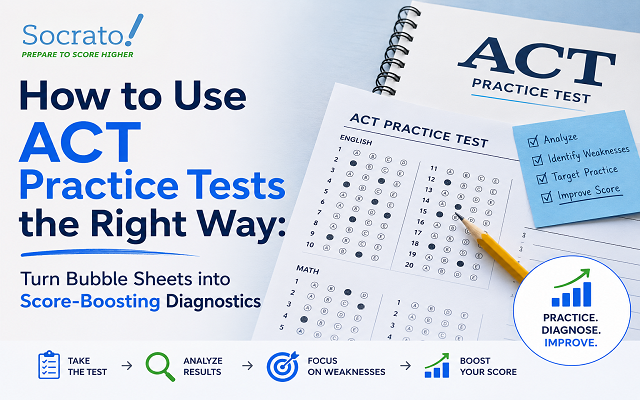
How to Use ACT Practice Tests the Right Way: Turn Bubble Sheets into Score-Boosting Diagnostics
Most students use an ACT Exam practice test like a thermometer: they take the test, check the score, and move on.
But students who consistently improve ACT scores treat practice tests differently.
They use every official ACT practice test as a diagnostic tool.
Instead of asking:
“What score did I get?”
High-scoring students ask:
“What is preventing my next score increase?”
That shift changes everything.
A single ACT practice test can reveal:
- Timing weaknesses
- Repeated careless mistakes
- Question-type struggles
- Pacing problems
- Section fatigue
- Strategy breakdowns
When reviewed properly, your ACT bubble sheet becomes a roadmap for improvement — not just a score report.
For students, tutors, and tutoring companies, this is one of the smartest ways to boost ACT performance.
Why Official ACT Practice Tests Matter
Official ACT practice tests remain one of the most effective ways to prepare for the real exam because they simulate:
- Real timing pressure
- Paper-based pacing
- Multi-section endurance
- Bubble-sheet accuracy
- Test-day mental fatigue
- Get familiar with the real Test question.
Many students practice casually online but struggle during full-length paper exams because they are not used to:
- Bubbling answers quickly
- Maintaining focus for several hours
- Managing time under pressure
- Recovering after difficult sections
That is why experienced ACT tutors still rely heavily on:
- Official ACT paper practice tests
- Timed practice sessions
- Bubble-sheet simulations
- Full-length weekend testing
But the biggest gains happen during the review process.
1. Mimic the Real ACT Testing Environment
Your brain adapts to the conditions you practice in.
If you take ACT practice tests while multitasking, listening to music, or taking unlimited breaks, your preparation will not reflect real testing conditions.
Follow the “Saturday Morning Rule”
Take your ACT practice test:
- Early in the morning
- At a desk or table
- In a quiet room
- Under strict timing conditions
This trains your brain for real ACT test-day fatigue and focus.
Use Paper Tests and Bubble Sheets
The ACT is still largely a paper-based exam experience.
Students should:
- Print official ACT practice tests
- Use a No. 2 pencil
- Bubble answers manually
- Practice section pacing realistically
Even bubbling answers is a skill.
Many students lose time simply because they are not comfortable managing:
- Test booklet navigation
- Bubble-sheet pacing
- Section transitions
Follow Strict Timing
No extra minutes.
No paused timers.
No checking your phone.
Use:
- A silent watch
- A countdown timer
- Official ACT section timing
Realistic timing is essential for accurate ACT score prediction.
2. Use the “Blind Review” Method
One of the best ACT test review strategies is called Blind Review.
Before checking the answer key:
- Go back to questions you marked as uncertain
- Retry them without timing pressure
- Compare your new answers with your original choices
This helps students identify whether the problem is:
- Timing pressure
- Careless mistakes
- Content gaps
- Weak strategy
For example:
- If you solve it correctly during review, pacing may be the issue
- If you still miss it, the concept likely needs improvement
This is one of the fastest ways to improve ACT scores efficiently.
3. Create an ACT Error Log
One of the biggest mistakes students make is reviewing passively.
Simply saying:
“Oh, I understand now.”
does not create long-term improvement.
Instead, every missed ACT question should be categorized.
The Three Main ACT Error Types
| Error Type | What It Means | How to Fix It |
| Careless Mistake | Misread question, bubbling error, simple calculation mistake | Slow down and focus on accuracy |
| Content Gap | Missing grammar rule, math formula, or reading skill | Review the specific concept |
| Strategy Issue | Poor pacing or spending too long on difficult questions | Practice skipping and time management |
This type of ACT diagnostic analysis helps students identify patterns quickly.
Many tutoring companies now use online grading tools and diagnostic systems to automate this process and generate faster feedback from ACT practice bubble sheets.
Platforms such as Socrato can help tutors and students organize grading data, identify recurring student weaknesses, and create more targeted ACT prep plans.
4. Understand Why the Correct Answer Works
ACT improvement is not just about knowing the correct answer.
Students must understand:
- Why the correct answer is correct
- Why the other choices are wrong
- How the ACT creates distractor answers
The ACT is designed to include “almost correct” options that trap rushed students.
For example:
- ACT Reading often includes partially correct answer choices
- ACT English may include grammatically correct but stylistically wrong answers
- ACT Science may use misleading graph interpretations
- ACT Math may include answers based on common calculation errors
Understanding these patterns improves decision-making speed during the actual exam.
5. Focus on the Highest-Impact Improvements
Students should not try to fix every weakness at once.
The smartest ACT prep focuses on the areas that generate the fastest score gains.
ACT English
Consistently missing punctuation or comma questions?
A focused grammar review can quickly improve accuracy.
ACT Math
Missing the last 10 questions repeatedly?
The issue may be pacing — not math ability.
Improving speed earlier in the section creates buffer time for harder questions.
ACT Science
Spending too much time reading introductions?
Most ACT Science questions are solved through graph and data interpretation.
Students often improve faster by learning how to locate information efficiently.
Why Automatic Bubble Sheet Grading Helps
For students and tutoring academies, manually grading ACT practice tests can be slow and inconsistent.
Automatic bubble-sheet grading tools help by:
- Saving grading time
- Reducing scoring errors
- Generating faster score reports
- Tracking student progress over time
- Organizing diagnostic data
This becomes especially valuable for:
- ACT bootcamps
- Tutoring centers
- Group classes
- Weekly practice testing programs
Detailed ACT diagnostic reports allow tutors and students to focus on:
- Weak content areas
- Timing breakdowns
- Recurring mistakes
- Score trends
Instead of spending hours calculating results manually, tutors can spend more time teaching strategy and reviewing mistakes.
The Bottom Line
An ACT practice test without deep review is just another three-hour exercise.
The real value of official ACT practice tests comes from the insights hidden inside the mistakes.
When students analyze:
- Timing patterns
- Error types
- Weak concepts
- Bubble-sheet data
- Strategy breakdowns
they begin turning practice tests into score-improvement systems.
That is how students move from:
- 22 to 26
- 26 to 30
- 30 to 34+
Use every ACT practice test as a diagnostic opportunity, and your scores will improve far more consistently. To learn the smart preparation strategy check out the free ACT ebook.