
How Diagnostic Testing Finds Learning Gaps: SAT, ACT, SSAT?
Why a practice test without analysis is just a number, and how students and tutors can turn every SAT, PSAT, ACT, SSAT, ISEE or HSPT practice test into a clear map of what to fix nextKey Takeaways
- A practice test only measures a score. The analysis afterward is what improves it.
- This is true for every major U.S. standardized test, from middle school entrance exams like the SSAT, ISEE and HSPT to college admission tests like the SAT and ACT.
- Two students with the same score can have completely different learning gaps. The total score hides the reasons.
- Diagnostic analysis works in layers: the overall score, then sections, then skill areas, then individual questions, then patterns across several tests.
- Not every wrong answer means “I didn’t know it.” Unfamiliar question formats, misreading, strategy, timing and careless errors each need a different fix.
- For tutors, the diagnostic review is the most valuable session you run. It’s where a generic course turns into a personal plan.
The Practice Test Is Only Half the Work
Experienced tutors see the same pattern with every test and every age group. A seventh grader preparing for the SSAT, an eighth grader preparing for the HSPT, and a junior preparing for the SAT or ACT all tend to do the same thing: take a full-length practice test, check the score, feel good or discouraged, and book the next test. A few weeks and several tests later, the score is about where it started.
These students haven’t been lazy. They’ve done the hardest part, sitting through two or three hours of focused testing. They just stopped at the point where the useful work begins.
A practice test is like a medical scan. The scan itself doesn’t make anyone healthier. Its value comes from someone reading it carefully, finding what’s wrong, and choosing the right treatment. A practice test that nobody analyzes question by question is a scan that never gets read.
That reading is what diagnostic testing means. It isn’t a special kind of test. It’s a way of using any standardized practice test to find exactly where and why points are being lost.
What Is Diagnostic Testing?
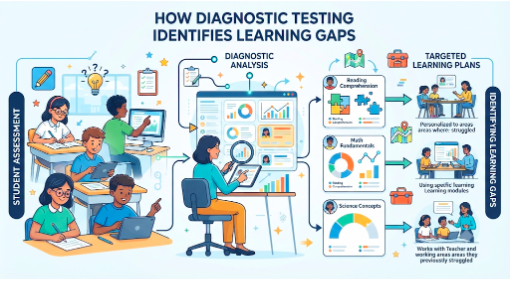
Diagnostic testing means taking a full-length, realistic practice test and analyzing the results in enough detail to identify specific learning gaps and plan what to study next.
The difference between an ordinary practice test and a diagnostic test isn’t the test. It’s what happens afterward:
| Practice test only | Diagnostic test | |
| Goal | Get a score | Find out why the score is what it is |
| Output | One number | A list of specific gaps, ranked by impact |
| What happens next | Take another test | Study the exact skills and habits that cost points |
| Effect on score | Usually flat | Steady, explainable improvement |
Which Tests Does This Apply To?
All of them. The tests differ in content and format, but each one produces the same kind of evidence: questions answered right, wrong, guessed or skipped, by section and skill. Knowing each test’s format tells you what to look for.
| Test | Who takes it | Scored sections | What to watch for in a diagnosis |
| SAT / PSAT | High school students (college admission, National Merit) | Reading and Writing; Math | Digital and adaptive by module: accuracy on the first module of each section affects the second |
| ACT | High school students (college admission) | English, Math, Reading; Science is optional | Fast pacing; decide whether Science is worth taking based on practice results |
| SSAT | Students in grades 3–11 applying to independent schools | Verbal, Quantitative, Reading | Unfamiliar formats (synonyms, analogies); Middle and Upper Levels subtract a fraction of a point for wrong answers, so guessing decisions matter |
| ISEE | Students in grades 1–12 applying to independent schools | Verbal Reasoning, Quantitative Reasoning, Reading Comprehension, Mathematics Achievement | Quantitative comparison questions; two separate math sections test different abilities |
| HSPT | Eighth graders applying to Catholic and other private high schools | Verbal Skills, Quantitative Skills, Reading, Mathematics, Language | Extremely fast pacing (Verbal Skills is 60 questions in 16 minutes); no calculator |
The essays and writing samples on these tests are generally unscored or reviewed separately by schools, so this guide focuses on the multiple-choice sections.
Where to Find Your Question-Level Results
You can’t diagnose without seeing each question. Here is where that data usually comes from:
- SAT and PSAT: After a full-length practice test in the Bluebook app, College Board’s free My Practice site shows every question, the correct answer, the answer you selected, and an explanation of each answer choice.
- ACT, SSAT, ISEE and HSPT: Use official practice tests or prep books from the test maker, and score them with the answer key. Mark every answer as right, wrong, guessed or skipped, then use the explanations where they’re available.
- Paper tests in a tutoring center or school: Score bubble sheets quickly, ideally with software that records each student’s answer to each question, so the analysis can start while the test is still fresh.
Most students glance at the score and stop there. The diagnostic work is everything they skip.
Why the Total Score Hides Your Learning Gaps
Imagine a student who misses 12 math questions on a practice test. The score report shows one math score. Diagnostic analysis might show something like this:
- 3 questions on fractions and ratios: a real content gap
- 2 questions in a format the student had never practiced, such as quantitative comparisons on the ISEE or number series on the HSPT
- 2 questions where the student solved the problem but answered a different question from the one asked: misreading
- 2 questions rushed in the final minutes of the section: timing
- 2 questions with an arithmetic slip on a problem the student knew how to do: careless errors
- 1 very hard question: a reasonable miss at the student’s current level
Only 3 of the 12 misses call for studying new content. If this student responds by re-studying all of math, they spend most of their time on the wrong problem. The score stays flat, and the student concludes that “studying doesn’t work for me.”
The score says how much. The diagnosis says what and why.
The 7 Types of Learning Gaps a Diagnostic Reveals
When tutors analyze practice tests carefully, nearly every lost point falls into one of seven categories, whatever the test. Each needs a different fix.
1. Content Gaps: “I didn’t know this”
The student doesn’t know the rule, formula, word or concept. Examples: what benevolent means, how to find the area of a trapezoid, when to use a semicolon, how a percent increase works.
What it looks like: Missing the same kind of question across sections and tests, even with plenty of time.
The fix: Targeted instruction on that one skill, then focused practice until it’s automatic.
2. Format Gaps: “I’ve never seen a question like this”
Standardized tests use question types students rarely see in school: analogies and synonyms on the SSAT, quantitative comparisons on the ISEE, number series and verbal logic on the HSPT, data-heavy passages on the ACT, or short single-question passages on the digital SAT.
What it looks like: Missing a whole question type, even when the underlying skill is easy for the student.
The fix: Learn how each question type works and practice it until the format feels routine. This is often the fastest gap to close, especially for younger students taking entrance exams.
3. Application Gaps: “I know it, but not in this form”
The student knows the concept in class but doesn’t recognize it when the test words it differently, puts it in a real-world setting, or combines it with another idea.
What it looks like: “Oh, I know how to do this!” when reviewing the answer.
The fix: Practice many test-style versions of the same skill, so the student learns to recognize its different forms.
4. Reading Gaps: “I answered a different question”
The student misread the question, missed a key word like not, except or least, solved for the wrong quantity, or chose an answer that’s true but doesn’t answer the question asked.
What it looks like: The work is correct, but the final answer is wrong.
The fix: A habit: underline what’s being asked before solving, and reread the question before choosing an answer.
5. Strategy Gaps: “I took the long way”
The student gets the right answer but uses a slow method: calculating exactly when estimating would do, not eliminating wrong choices, or not using available tools such as the built-in calculator on the digital SAT.
What it looks like: Correct answers that took two or three times as long as they should, which hurts timing later.
The fix: Learn faster approaches (estimation, elimination, working backward from the answer choices) and practice them until they become the default.
6. Timing and Stamina Gaps: “I ran out of time or energy”
Accuracy drops toward the end of a section, or later sections are noticeably weaker than earlier ones. This is especially common on fast-paced tests like the HSPT and ACT, and for younger students sitting for a long entrance exam for the first time.
What it looks like: Mistakes cluster in the last part of a section, or unanswered and rushed questions appear late.
The fix: Pacing checkpoints, a two-pass strategy (answer the sure ones, mark the slow ones, return later), and full-length timed practice to build stamina.
7. Accuracy Gaps: “I knew it, but slipped”
Careless errors: a sign dropped, the wrong bubble filled in, a calculation rushed.
What it looks like: Mistakes on easy questions the student clearly understands. On the adaptive digital SAT, these matter even more on the first module of each section, because performance there decides whether the second module is easier or harder. On paper tests, check for bubbling errors too: one skipped line can shift a whole run of answers.
The fix: A short checking routine for high-risk steps, plus slowing down slightly on questions that look easy.
The hidden gaps: lucky guesses and costly guesses
A question you guessed and got right still counts as a gap. The score says you know it, but you don’t, and the next test may not be as kind. Good diagnostic analysis reviews every guessed question, not just the wrong ones.
Guessing also needs its own diagnosis because the rules differ by test. The SAT, ACT, ISEE and HSPT don’t penalize wrong answers, so a blank is always a lost chance. The SSAT Middle and Upper Levels subtract a fraction of a point for each wrong answer, so students need to learn when an educated guess is worth it. (Rules can change, so always confirm with the test maker’s current guide.)
How to Analyze a Practice Test: The 5 Levels
Diagnostic analysis moves from the big picture to the details, then back to the big picture.
Level 1: The overall score. Note it, then move on. On its own, it only tells you where you stand.
Level 2: Sections. Compare verbal, reading and math sections. Which one is pulling the score down? On the digital SAT, also look at how you did in the first module of each section.
Level 3: Skill areas. Group misses by skill or question type. For example:
- Math and quantitative sections: arithmetic and number sense, fractions and percents, algebra, geometry, data and probability, quantitative comparisons, number series
- Verbal and reading sections: vocabulary, synonyms and analogies, main idea, inference, author’s purpose, evidence
- Writing and language sections: grammar, punctuation, sentence structure, transitions
Your weakest one or two areas are your first priorities.
Level 4: Question by question. For every missed, guessed and skipped question, ask four things:
- What skill or question type was this testing?
- Why did I miss it? (content, format, application, reading, strategy, timing or accuracy)
- What should I have noticed or done differently?
- How will I avoid this next time?
Record the answers in an error log:
| Test | Q# | Section | Skill / question type | Gap type | What went wrong | Next-time rule |
| SSAT | 18 | Verbal | Analogies | Format | Didn’t know how to set up the relationship | Build a sentence linking the two words first |
| ISEE | 7 | Quantitative Reasoning | Quantitative comparison | Strategy | Calculated both sides exactly; ran short of time | Simplify or estimate before calculating |
| HSPT | 52 | Verbal Skills | Antonyms | Timing | Rushed the last 10 questions | Check the pace at the halfway point |
| SAT | 14 | Math, Module 1 | Linear equations | Reading | Solved for x; question asked for 3x | Underline what’s asked before solving |
| ACT | 31 | English | Punctuation | Content | Unsure when to use a colon | Review colon rules; do 15 practice questions |
Level 5: Patterns across tests. One test is a snapshot. Two or three analyzed tests show a trend. A gap that appears on every test is a priority. One that appeared once may have been a bad day.
Reading the Patterns: What Your Error Log Is Telling You
| If you see… | It usually means… | Do this |
| Misses spread across one skill area | A content gap | Study that area with targeted lessons and practice |
| Misses concentrated in one question type | A format gap | Learn how that question type works; practice it on its own |
| Misses on easy questions | Accuracy or reading gaps | Build checking habits; slow down on “easy” questions |
| Misses or blanks cluster at the end of sections | Timing or stamina gaps | Pacing checkpoints, two-pass strategy, full-length timed practice |
| “I knew that” after reading the answer | Application or reading gaps | Practice test-style versions; underline what’s asked |
| Lots of correct-but-slow answers | Strategy gaps | Learn estimation, elimination and working backward |
| Many lucky guesses in one skill area | A hidden content gap | Treat it like a wrong answer and review it |
| Many wrong guesses on a test with a guessing penalty | A guessing-strategy gap | Practice when to guess and when to skip |
For Students: A Review Routine After Every Practice Test
Do this within a day or two of the test, while you still remember your thinking. Older students can do it on their own in about 90 minutes. Younger students preparing for the SSAT, ISEE or HSPT should do it with a parent or tutor, in two shorter sittings if needed.
- Look at the score for five minutes, then move on. Don’t let it decide your mood for the week.
- Mark every question as right, wrong, guessed or skipped.
- Re-attempt each wrong, guessed and skipped question before checking the answer. If you get it right the second time with no time pressure, it probably wasn’t a content gap.
- Read the explanation, including why the wrong answers are wrong.
- Label each miss with one of the seven gap types and fill in your error log.
- Count your gap types. Which type cost you the most points?
- Write down your top two priorities for the next one to two weeks. Two is enough.
Then spend your study time on those two priorities, not on another full test right away.
Common Mistakes in Practice Test Analysis
- Only reviewing wrong answers. Lucky guesses and skipped questions hide real gaps.
- Reading the explanation before re-trying. You lose the chance to find out whether you could have solved it.
- Labeling everything “careless.” It feels better than “I didn’t know it,” but it leads to the wrong fix.
- Taking the next test too soon. Without time to work on gaps, the next test usually repeats the last one.
- Testing in unrealistic conditions. Untimed or interrupted tests produce misleading data, especially for timing gaps.
- Using the wrong level or version of the test. SSAT and ISEE levels differ by grade, and the ACT and SAT have both changed in recent years. Practice with materials that match the test the student will actually take.
- Trying to fix everything at once. Focus on two priorities at a time.
Frequently Asked Questions
What is a diagnostic test?
It’s a full-length, timed practice test that is analyzed in detail to find specific strengths and learning gaps by section, skill area, question type and timing. The analysis, not the test itself, is what makes it diagnostic.
Does diagnostic testing work for the SSAT, ISEE and HSPT, or only the SAT and ACT?
It works for all of them. Every standardized test produces question-level results that reveal content, format, timing and accuracy gaps. For middle school entrance exams, format gaps are often the biggest and fastest to fix, because students rarely see these question types in school.
How do I analyze a practice test?
Start with section results, then group your misses by skill area and question type. Next, review every missed, guessed and skipped question, identify why you missed it, and record it in an error log. After two or three tests, look for patterns and focus on your top two priorities.
How often should students take a diagnostic practice test?
Many students and tutors use a full-length test every four to six weeks, with short skill practice in between. The right pace depends on the test date, but always leave time to work on gaps between tests.
Should students guess on standardized tests?
It depends on the test. The SAT, ACT, ISEE and HSPT don’t penalize wrong answers, so students should answer every question. The SSAT Middle and Upper Levels subtract a fraction of a point for wrong answers, so students should guess only when they can eliminate at least one choice. Check the test maker’s current rules before test day.
Why isn’t my score improving even though I take practice tests?
Usually because the tests are being used to measure, not to learn. Without analyzing each question and changing what you study, the same mistakes repeat. Our post on the 5 signs you’re preparing for the SAT the wrong way covers this in detail, and most of it applies to other tests too.
The Bottom Line
Whether a student is in seventh grade preparing for the SSAT or eleventh grade preparing for the ACT, the rule is the same. A practice test tells you where you are. Diagnostic analysis tells you why, and that’s the part that moves a score.
For students, it means spending as much care on reviewing a test as on taking it. For tutors or parents , it means making the diagnostic review the center of every study plan. When every practice test becomes a diagnostic, score improvement stops feeling like luck and becomes something you can plan.