
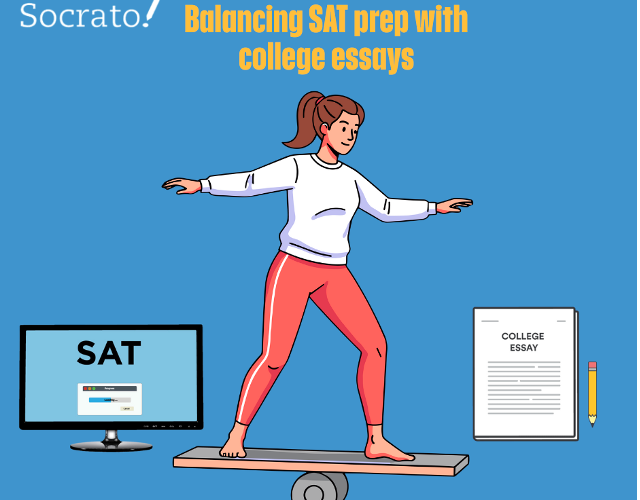
Balancing SAT prep with college essays
You’ve spent months—or maybe years—memorizing formulas, practicing reading passages,
timing math sections on a digital device, and chasing incremental score improvements.
Suddenly, your college application says: write about a meaningful experience. No multiple
choice. No timer breathing down your neck. Just your voice.
Before you toss your test strategies aside, note this: SAT prep teaches a set of thinking
habits that are quietly powerful for essay writing. Here’s how they map over.
To balance SAT prep and college essays, create a weekly schedule that prioritizes the more
urgent task while integrating the other. For example, dedicate 60-70% of your time to SAT
prep in the weeks before a test, while using short, focused sessions for essay brainstorming
and drafting. As the test deadline passes, shift your focus to heavy essay revision. You can
also make the tasks work together by using SAT reading skills to improve essay analysis and
timed SAT writing drills to sharpen essay clarity.
Sample weekly schedule
–Monday: 20 minutes of vocabulary drills + 30 minutes of essay brainstorming.
–Wednesday: 90 minutes of SAT practice (timed section).
–Friday: 20 minutes of math drill + 30 minutes of essay editing.
–Saturday: 3-hour block for either a full SAT practice test or dedicated essay
writing/editing.
–Sunday: 30 minutes for review and planning the next week.
Strategies for integrating both tasks
–Use SAT practice for essay material: Treat a dense SAT reading passage like a
researcher. Annotate strong metaphors, note the tone shifts, and pull three
descriptive phrases you could adapt for your essay.
–Improve essay skills through SAT drills: Use timed writing drills to sharpen your
clarity and conciseness, skills that are useful for both SAT Writing & Language
questions and your essays.
–Turn SAT weaknesses into essay topics: If you struggle with a particular area on the
SAT, like evidence interpretation, consider writing an essay about how you
developed your ability to think critically.
–Time management: Use techniques like the Pomodoro Technique for focused study
sessions (e.g., 25 minutes of focused work followed by a 5-minute break).
–Prioritize and shift focus: Before a test, your schedule should heavily favor SAT prep.
After the test, you can flip the balance to focus more on essay writing and revision.
Get selective feedback: Ask a trusted teacher, advisor, or mentor for one in-depth
round of feedback on your essay rather than many shallow rounds.