
SAT Score Not Improving? 5 Signs You’re Preparing for the SAT the Wrong Way
Why scores stall even after practice test after practice test, and what experienced SAT tutors see again and again
The Score Plateau
Ask any experienced SAT tutor which complaint they hear most, and the answer is almost always the same: “I keep taking practice tests, but my score isn’t going up.”
The pattern is remarkably consistent. A student takes a first practice test and lands somewhere in the low 1200s. Over the next few weeks, they take several more. The scores bounce around, up 20 points, down 30, up 10, but the average doesn’t move. The student is putting in real hours, which is exactly what makes the plateau so discouraging.
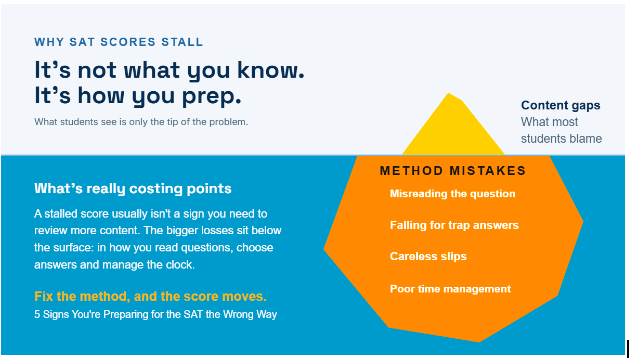
When tutors look closely at how these students prepare, effort is rarely the problem. The method is. It’s like running on a treadmill: sweating, putting in hours, and staying in the same place.
In most cases, the plateau traces back to one belief that nearly every high schooler holds without ever saying it:
“The SAT tests everything I’ve learned from Grade 1 to Grade 12, so if I review everything, my score will go up.”
That belief is understandable, but it’s wrong, and it’s costing you points.
School is a library. Over twelve years you collected thousands of books: fractions, photosynthesis, the French Revolution, the quadratic formula, To Kill a Mockingbird, the parts of a cell.
The SAT works more like a locksmith’s exam. The same 30 or so locks show up again and again in slightly different disguises, and you have a few minutes to open each one. Rereading the library doesn’t help much. Learning those specific locks, and practicing until you can open them fast, does.
School rewards knowing. The SAT rewards recognizing: spotting what a question is really testing, picking the fastest route, and avoiding the trap the test-makers built into the answer choices.
Here are the five signs that you’re studying for school when you should be training for the SAT, and what to do instead.
Sign #1: You measure progress by how many practice tests you’ve taken
What you’re thinking: “More tests = more practice = higher score. I’ll take one every weekend.”
What’s actually happening: Taking a practice test is just measuring. Taking your temperature ten times won’t cure your fever. If you finish a test, check your score, feel good or bad about it, and move on to the next one, you are repeating the same mistakes on a schedule.
The improvement comes from what happens after the test.
The fix: the 1:2 rule and a mistake journal
For every hour you spend taking a test, spend two hours reviewing it. For each question you got wrong, and each one you guessed right, write one line in a mistake journal:
| Question | My answer | Correct | Why I missed it | What I’ll do next time |
| M1 #14 | B | D | Solved for x, but the question asked for 2x | Underline what the question asks before solving |
| RW #9 | A | C | Picked an answer that “sounded smart” but wasn’t in the text | Find the line in the passage that proves my answer |
Then label every miss with one cause:
- Content gap: I didn’t know the rule or concept.
- Misread: I answered a different question from the one asked.
- Trap: I fell for a tempting wrong answer.
- Careless: I knew it, but made an arithmetic or clicking slip.
- Time: I rushed or never got to it.
After two or three tests, a pattern shows up. Most students find that more than half their lost points are not content gaps. They’re misreads, traps, and careless errors, and rereading a textbook won’t fix any of those.
Sign #2: You’re re-studying all of school, cover to cover
What you’re thinking: “I should review everything from Algebra 1 through Precalc, plus all my English grammar, plus vocabulary lists, just in case.”
What’s actually happening: “Just in case” studying is the most expensive habit in test prep. The digital SAT is narrow and predictable. It has two sections, Reading and Writing and Math, and each one tests a fixed set of skill areas:
Reading and Writing: 4 domains
- Craft and Structure: word meaning in context, the purpose of a text, how two texts connect
- Information and Ideas: central ideas, evidence (including from charts and tables), inferences
- Standard English Conventions: punctuation, sentence boundaries, verb and pronoun agreement
- Expression of Ideas: transitions, and combining notes to meet a stated goal
Math: 4 domains
- Algebra: linear equations, inequalities, systems, linear functions
- Advanced Math: quadratics, exponentials, polynomials, function notation
- Problem-Solving and Data Analysis: ratios, percentages, rates, statistics, probability
- Geometry and Trigonometry: area and volume, angles, triangles, circles, right-triangle trig
The test does not cover calculus, chemistry, history facts, literary analysis of novels you read in class, or a long vocabulary list. Algebra and Advanced Math make up most of the Math section, so a student who truly masters linear equations, systems, quadratics, and functions has covered the biggest part of it.
The fix: study the map, not the library
Use your mistake journal to find your weakest two domains. Spend 70% of your study time there. Drill one skill until you can do it accurately and quickly, then move to the next. Work deep on a few skills rather than lightly on everything.
Sign #3: You read Reading and Writing questions like an English class assignment
What you’re thinking: “In English class, I get credit for creative interpretation. If I can argue for an answer, it’s probably right.”
What’s actually happening: This is the biggest mindset shift students need to make. In English class, several interpretations can earn an A if you defend them well. On the SAT, there is exactly one right answer, and the proof is written in the passage. Every wrong answer is designed to be defensible to a creative mind.
The SAT doesn’t want your opinion. It wants your evidence.
The fix: a five-step method for every Reading and Writing question
Each digital SAT question has its own short passage, so you can apply the same routine every time:
- Read the question first. Know your job before you read. Are you finding the main idea? Filling a blank? Choosing a transition?
- Read the passage with that job in mind. You’re looking for evidence, not enjoying the story.
- Predict the answer in your own words before looking at the choices. If the blank needs a word meaning “surprising,” say “surprising” in your head first.
- Eliminate with the four wrong-answer traps:
- Too extreme: “always,” “never,” “completely,” “proves”
- Out of scope: sounds reasonable, but the passage never says it
- True but irrelevant: accurate, but doesn’t answer this question
- Half right: the first half matches, the second half goes wrong
- Point to the proof. If you can’t put your finger on the words in the passage that support your answer, don’t pick it.
Specific tactics for the most common question types:
- Grammar (Conventions): Don’t go by “what sounds right.” Your ear was trained on casual speech. Learn the rules. Know what a semicolon needs on both sides (two complete sentences), what a colon does (introduces an explanation or list), and how to find the real subject of a verb by mentally crossing out the extra phrase in between.
- Transitions: Before looking at the choices, label the relationship between the two sentences: contrast, cause and effect, continuation, or example. Then choose the word that matches. “However” and “Therefore” can’t both be right.
- Rhetorical Synthesis (the “notes” questions): These are the easiest points on the test once you know the secret: the goal in the question is everything. Read the goal first (“The student wants to emphasize a difference between the two species…”). Then pick the only answer that does exactly that. You often don’t need to read all the notes.
Sign #4: You solve SAT math the way you do homework
What you’re thinking: “My teacher wants to see all my work. The proper way is to solve the full equation step by step.”
What’s actually happening: Your math teacher grades your process. The SAT grades only your answer. Nobody gets bonus points for elegant algebra. Students who solve every problem the long way run out of time, and students who rush to keep up make careless errors.
The fix: read the last line first, then choose the fastest route
Step 1: Underline what they’re actually asking. This one habit can save a student 20 to 30 points. Look at this:
If 3x + 5 = 20, what is the value of 6x + 10?
A homework brain solves for x = 5, then plugs it back in. An SAT brain notices that 6x + 10 is just 2 × (3x + 5), so the answer is 2 × 20 = 40, in about three seconds. Even worse is the student who solves x = 5, sees 5 among the answer choices, and clicks it. That’s exactly the trap the test-makers set.
Step 2: Pick your route. For every math question, ask: what’s the fastest way to the answer?
- Algebra: when the setup is clean and short.
- The built-in Desmos graphing calculator: for systems of equations (graph both and click the intersection), quadratics (the vertex and roots show up right on the graph), and “how many solutions” questions. Many students never practice with Desmos, and they’re giving away free time.
- Plug in the answer choices: when the choices are numbers and the algebra is messy, test them, starting with the middle value.
- Pick your own numbers: when the question and answers use variables, substitute easy numbers like 2 or 10 and see which choice matches.
Step 3: Make the student-produced-response questions safe. Some math questions have no answer choices. Double-check that your answer is in the form they asked for (fraction or decimal, which variable, which units).
Sign #5: You treat every question the same and never practice the actual test
What you’re thinking: “I’ll go in order. If I get stuck, I’ll keep trying until I get it. That’s what persistence means.”
What’s actually happening: Persistence is great for homework but costly on a timed test. The digital SAT gives you about 71 seconds per Reading and Writing question and about 95 seconds per Math question. Spending four minutes on question 12 means you rush questions 18 through 22, which may be easier.
There’s a second layer: the digital SAT is adaptive. Each section has two modules, and how you do on Module 1 decides whether Module 2 is easier or harder. The harder second module is the path to the highest scores. So a careless mistake on an easy Module 1 question costs you more than it looks like.
The fix: play the test like a strategist
- Two-pass strategy: On your first pass, answer everything you’re confident about and flag anything that takes more than about 90 seconds. On your second pass, go back to the flagged questions with the time you’ve banked.
- Never leave a blank. There’s no penalty for wrong answers. Eliminate what you can, guess, flag it, and move on.
- Protect Module 1. Slow down just enough on the first module to avoid careless errors. Accuracy there sets up everything after it.
- Practice in the real format. The SAT is taken on a screen in College Board’s Bluebook app. Practicing only on paper means you’re training for a different test. Take full-length practice in Bluebook, timed, in one sitting, with the 10-minute break, so test day feels familiar.
What the Right Way Looks Like
If you recognized yourself in two or more of these signs, the good news is that your score isn’t stuck. Your method is. Here’s a weekly rhythm that works much better than “one more practice test”:
| Day | Focus | What you do |
| Day 1 | Diagnose | Take one timed section (or a full test every 2–3 weeks) in Bluebook |
| Days 2–3 | Review | Fill in your mistake journal. Label every miss by cause |
| Days 4–5 | Target | Drill your weakest 1–2 skills with 15–20 focused questions each |
| Day 6 | Strategy | Practice one technique: Desmos, plugging in, predicting answers, two-pass timing |
| Day 7 | Rest | Seriously. Tired brains make careless mistakes |
Do this for four to six weeks and watch what happens to your mistake journal. The content gap column shrinks slowly. The misread, trap, and careless columns shrink fast, and that’s usually where the first 50 to 100 points come from.
The Bottom Line
You’ve spent twelve years becoming a good student. The SAT asks you to become a good test-taker, which is a different skill. It’s not harder, and it’s a lot more learnable than most students think.
So stop rereading the whole library and start learning the locks.
Frequently Asked Questions
Does the SAT test everything I learned in school?
No. The digital SAT tests a defined set of skills in two sections. Reading and Writing covers four areas: Craft and Structure, Information and Ideas, Standard English Conventions, and Expression of Ideas. Math covers Algebra, Advanced Math, Problem-Solving and Data Analysis, and Geometry and Trigonometry. Calculus, science facts and literature analysis aren’t on the test.
How long should I spend reviewing an SAT practice test?
A good rule is about two hours of review for every hour of testing. Go through every question you missed or guessed on, and label each one by cause: content gap, misread, trap, careless error or timing. That’s where most score gains come from.
Is there a penalty for guessing on the SAT?
No. Wrong answers don’t cost you points, so never leave a question blank. Eliminate what you can, make your best guess, flag the question and move on.
Can I use a calculator on the whole SAT Math section?
Yes. The digital SAT includes a built-in Desmos graphing calculator for every Math question, and you can also bring an approved calculator. Practice with Desmos before test day. It’s often the fastest way to solve systems of equations and quadratics.