
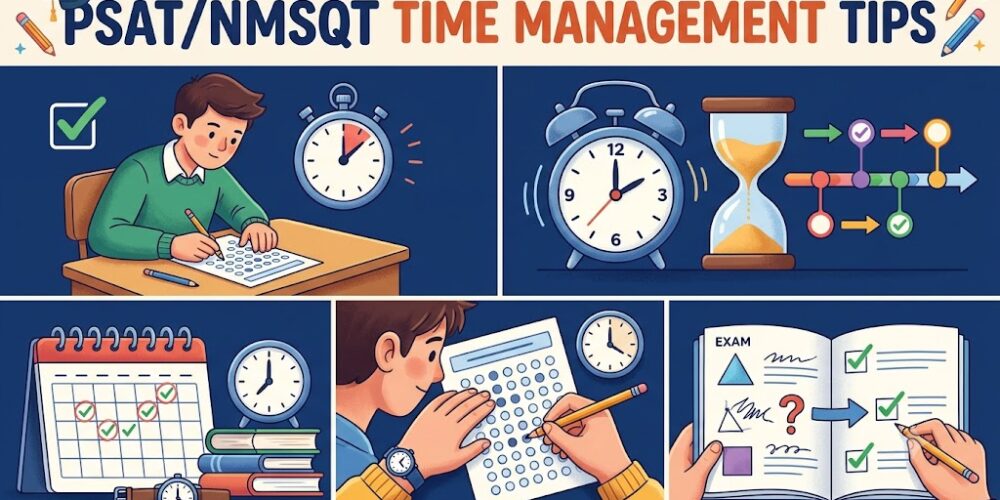
PSAT/NMSQT Time Management Tips: How to Pace Yourself on Every Section
This is the last week of the fall 2026 PSAT/NMSQT testing window, which closes October 31st.. If you are a junior and have not taken the PSAT yet, this is your chance: only the junior-year score counts toward National Merit, and a missed test is hard to make up. Check with your school counselor today to confirm your test date or ask what your school offers this week.
You can’t learn a year of math and grammar in a few days, but you can improve how you use the time on the test. This guide shows what each section tests, how to pace every module, and what to do in your final days so you walk in prepared and finish strong.
Last-week cheat sheet
Print this table, check it against your practice runs, and use it as your pacing guide on test day.
| Module | Questions | Time | Be at this question by the halfway mark | First pass done by | Review flagged questions |
|---|---|---|---|---|---|
| Reading and Writing, Module 1 and 2 | 27 | 32 minutes | About question 14 or 15 (at 16 minutes) | 27 minutes | Last 4 to 5 minutes |
| Math, Module 1 and 2 | 22 | 35 minutes | About question 11 (at 17 minutes) | 30 minutes | Last 4 to 5 minutes |
Where the points are. With a few days left, put your practice time where the test puts its questions:
- Algebra and Advanced Math make up about 70% of Math. Drill linear equations, systems, quadratics, and nonlinear functions, and learn to check them in Desmos.
- Standard English Conventions are 11 to 15 Reading and Writing questions and the fastest to answer, so it is the best place to bank time.
- Words in context and transitions are short questions that reward a quick prediction before you read the choices.
- Module 1 of each section sets how hard Module 2 is, so slow down for accuracy there.
If your test is in the next day or two
- Confirm your date, start time, location, and device rules with your school.
- Open Bluebook, confirm your device works, and charge it.
- Do one timed Reading and Writing module and one timed Math module, then review only the errors.
- Write your three most common mistakes on a card and read it before you start.
- Sleep, eat breakfast, and arrive early.
The digital PSAT/NMSQT at a glance
The test takes about 2 hours and 14 minutes, has 98 questions, and is taken in the Bluebook app.
| Section | Modules | Questions per module | Time per module | Section time |
|---|---|---|---|---|
| Reading and Writing | 2 | 27 | 32 minutes | 64 minutes |
| Math | 2 | 22 | 35 minutes | 70 minutes |
- Reading and Writing comes first, then a break of about 10 minutes, then Math. The two modules in a section are timed separately, with no break between them.
- Each module includes 2 unscored pretest questions. You can’t tell which ones they are, so treat every question as real.
- Time left in Module 1 does not carry into Module 2, so use each module’s time fully.
Why Module 1 matters most. Everyone sees the same Module 1 in a section. Your performance there decides whether Module 2 is the harder or easier version, and only the harder path leads to the top of the score range. Careful, accurate work in Module 1 is the best use of your time.
What your score means for National Merit
National Merit uses the Selection Index, which counts Reading and Writing twice. Your total score runs from 320 to 1520, and the Selection Index is calculated as follows:
\text{Selection Index} = \frac{2 \times \text{RW} + \text{Math}}{10}
The index ranges from 48 to 228. Because Reading and Writing is doubled, each point there moves your index more than a point in Math does. Semifinalist cutoffs are set state by state, and semifinalists are announced in September 2027. Only the junior-year PSAT/NMSQT counts.
Core pacing rules for every module
Pace to the module average, bank time early, and always review before time runs out.
- Know your average, not a fixed limit. Reading and Writing gives about 71 seconds per question (32 minutes for 27 questions). Math gives about 95 seconds per question (35 minutes for 22 questions). These are averages across the module, not a cap on each question.
- Questions get harder as a module goes on. Within each module, questions are grouped by skill and ordered from easiest to hardest. Move quickly through early questions and bank time for later ones.
- Do two passes. On pass one, answer everything you can, guess on anything stuck, and flag it with Mark for Review. On pass two, spend leftover time on the flagged questions, jumping through them with the question menu.
- Never leave a blank. The College Board advises that for most students guessing is better than leaving a question unanswered, especially after eliminating one or two choices. Use the option eliminator.
- Set a walk-away point. If you have spent about two minutes on a question and are not close, guess, flag it, and move on.
- Use the timer on your terms. Bluebook lets you hide the timer until 5 minutes remain. If a running clock makes you anxious, hide it and check at set points.
Reading and Writing: what it tests and how to pace it
Every question is multiple choice with one short passage, drawn from literature, history and social studies, the humanities, and science. Some include a table or graph.
| Domain | Approx. questions | What it tests |
|---|---|---|
| Craft and Structure | 13 to 15 | Words in context, text structure and purpose, connecting two texts |
| Information and Ideas | 12 to 14 | Central ideas, supporting details, using evidence, inferences |
| Standard English Conventions | 11 to 15 | Sentence boundaries, verb and pronoun forms, sentence structure, punctuation |
| Expression of Ideas | 8 to 12 | Rhetorical synthesis (using notes to meet a goal), transitions |
Suggested pacing targets (coaching guidelines, not official limits):
| Question type | Target time | Approach |
|---|---|---|
| Standard English Conventions | 30 to 45 seconds | Name the rule being tested, then test each choice. Don’t re-read the whole passage. |
| Words in context | 30 to 50 seconds | Read the sentence, predict a word before looking at the choices, then match. |
| Transitions | 30 to 45 seconds | Decide the logical relationship (contrast, cause, example, addition), then pick. |
| Central idea, details, structure and purpose | 60 to 80 seconds | Read the passage once for the main point, then check each choice against the text. |
| Evidence, inference, rhetorical synthesis, cross-text | 75 to 100 seconds | Match the exact claim or goal in the question. Wrong answers are often true but off target. |
Module checkpoints (32 minutes, 27 questions):
- At about 16 minutes: you should be around question 14 or 15.
- At about 27 minutes: finish your first pass.
- Final 4 to 5 minutes: return to flagged questions.
Tips
- Answer from the passage, not from outside knowledge. Every correct answer is supported by the text.
- On Convention questions, ignore your ear. Name the rule first, such as subject-verb agreement, a comma splice, or a modifier.
- On Expression of Ideas, reread the question’s goal (“emphasize a contrast,” “introduce the study”) before choosing.
- Reading and Writing counts double in the Selection Index, so protect your accuracy in Module 1.
Math: what it tests and how to pace it
The section mixes multiple-choice and student-produced response questions, where you type the answer. About 30% of questions are set in a science, social studies, or real-world context. A Desmos calculator is built into Bluebook for the whole section, you can also bring an approved handheld calculator, and a reference sheet of common formulas is available.
| Domain | Approx. questions | What it tests |
|---|---|---|
| Algebra | 13 to 15 | Linear equations and inequalities, linear functions, systems of two linear equations |
| Advanced Math | 12 to 14 | Equivalent expressions, quadratics and other nonlinear equations, nonlinear functions |
| Problem-Solving and Data Analysis | 7 to 9 | Ratios, rates, percentages, units, probability, data and statistics |
| Geometry and Trigonometry | 4 to 6 | Area, volume, angles, triangles, right-triangle trigonometry |
Algebra and Advanced Math together make up about 70% of the test, so they deserve most of your last-week review.
Suggested pacing targets (coaching guidelines, not official limits):
| Position in the module | Target time | Approach |
|---|---|---|
| Questions 1 to 8 (easier) | 45 to 70 seconds | Solve directly. Avoid over-checking. |
| Questions 9 to 16 (medium) | 80 to 110 seconds | Write out steps. Use Desmos to graph or check. |
| Questions 17 to 22 (hardest) | Up to about 2 minutes | If nothing works, guess, flag, and return. |
Module checkpoints (35 minutes, 22 questions):
- At about 17 minutes: you should be around question 11.
- In about 30 minutes: finish your first pass.
- Final 4 to 5 minutes: revisit flagged questions and double-check student-produced responses.
Tips
- Use Desmos for equations and systems. Type both equations to find the intersection, or graph a function to find a minimum or x-intercepts. This is often faster than algebra.
- Plug in answer choices when the algebra is messy.
- Check what the question asks. Many wrong answers solve for the wrong quantity, such as x when the question asks for 2x + 1.
- For student-produced responses, check the format: no units, and decimals or fractions entered correctly.
- Skip long word problems on the first pass if the setup is unclear, then come back.
Your plan for the final days before the test
Use the days left to check your pacing and fix your most common mistakes, not to cram new material.
3 to 4 days before
- Take one full-length practice test in Bluebook under real conditions: timed, in one sitting, on the device you will use on test day. Skip this if you are already running low on energy.
- Sort your errors into content gaps, careless mistakes, and timing problems.
- Spend time only on the most common mistakes in Algebra, Advanced Math, and Standard English Conventions.
1 to 2 days before
- Do light practice: a few timed Reading and Writing sets and a few Math sets.
- Confirm your test date, start time, location, what to bring, and device requirements with your school.
- Make sure the Bluebook app works and your device is charged.
The night before
- Pack what your school requires, including a charged device, a charger, and an approved calculator if you want a backup.
- Sleep. A rested brain adds more than another hour of practice.
Test morning
- Eat a real breakfast and bring water and a snack for the break.
- Arrive early and do a calming warm-up, such as two easy practice questions or a few deep breaths.
- Don’t discuss the Reading and Writing section during the break. It can’t be changed and it can throw off your Math focus.
Common PSAT pacing mistakes
Most lost points come from where time goes, not from missing knowledge.
- Spending 4 minutes on one hard question. It costs you three easier ones later.
- Rushing Module 1. That module sets your Module 2 difficulty.
- Skipping the review pass. A flagged question left unanswered is an easy point lost.
- Overthinking early questions. They are easier by design.
- Not using the tools. Desmos, the option eliminator, and Mark for Review exist to save you time.
- Letting one bad module ruin the next. Each module is a fresh start. Breathe, reset, and move on.
Frequently asked questions
How much time do I get per question on the PSAT? About 71 seconds in Reading and Writing and about 95 seconds in Math, on average.
Is there a penalty for guessing? The College Board advises that for most students guessing is better than leaving a question blank, so answer every question.
Can I use a calculator on the whole Math section? Yes. Desmos is built into Bluebook, and an approved handheld calculator is also allowed.
Does the PSAT adapt? Yes. Your performance on Module 1 of each section determines the difficulty of Module 2.
Which score does National Merit use? Only the junior-year PSAT/NMSQT counts. The Selection Index is (2 × Reading and Writing + Math) ÷ 10.
What if I can’t test this week? Contact your school counselor immediately to ask about your options. Don’t assume you can retake the test this fall.
Final thoughts
For this last testing week, aim for a calm, steady pace. Be careful in Module 1, move quickly through early questions in every module, guess and flag when you are stuck, and use the final minutes of each module to review. Add sleep and a solid test-day routine, and your score has its best chance.The per-question time targets are coaching estimates built from the official module timing, not College Board rules. Good luck with the exams.