
How Tutors Can Turn Every Official Bluebook Practice Test into a Personalized SAT Improvement Plan
The College Board Bluebook® app provides students with 10 official adaptive Digital SAT practice tests. These are the closest representation of the real exam and are an invaluable preparation resource.
Yet many students complete one practice test after another without making meaningful improvements.
The reason isn’t a lack of practice.
It’s a lack of analysis.
As tutors and academy owners, your goal isn’t simply to have students complete all ten tests—it’s to ensure that every practice test teaches them something that improves their score on the next one.
Practice Tests Don’t Increase Scores—Learning from Them Does
Many students believe that taking more practice tests automatically leads to higher SAT scores.
Unfortunately, that’s rarely how score improvement works.
A practice test is simply a measurement. The real improvement happens after the test, when students identify:
- Which concepts they truly understand
- Which topics consistently cause mistakes
- Whether errors are due to content gaps, timing, or careless mistakes
- Which difficulty levels they struggle with most
- What should be prioritized before the next practice test
Without this analysis, students often repeat the same mistakes across multiple exams.
What the Official Bluebook Report Shows
After completing a Bluebook practice test, students receive an official score report that includes information such as:
- Overall score
- Correct and incorrect answers
- Performance by broad content category
- Basic question review
This is helpful for understanding overall performance.
However, tutors who are trying to build an effective study plan often need answers to much deeper questions:
- Which specific math topics are consistently weak?
- Which grammar rules are costing the most points?
- Are mistakes concentrated in easy, medium, or hard questions?
- Are students missing advanced questions or foundational ones?
- Which areas offer the greatest score improvement opportunity?
Those insights simply aren’t available in the standard report.
The Missing Piece: Diagnostic Intelligence
Imagine two students who both score 1210.
Their scores are identical.
Their study plans should not be.
One student may struggle primarily with algebra and advanced math.
Another may understand the math but lose points because of reading comprehension and rhetorical synthesis.
A generic study plan helps neither student.
Personalized preparation begins with personalized diagnostics.
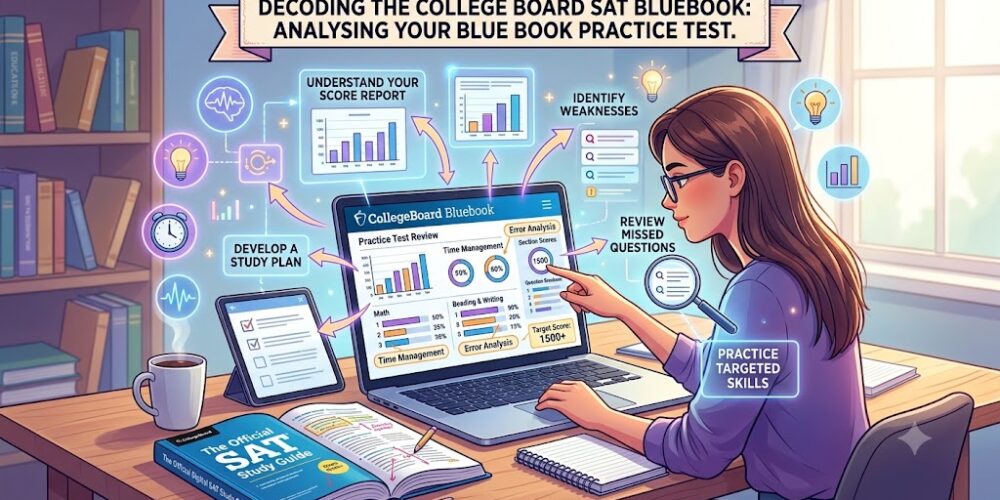
A Better Way to Use Every Bluebook Practice Test
Instead of treating each practice test as the end of a study cycle, treat it as the beginning of one.
An effective preparation workflow looks like this:
Step 1: Complete an official adaptive Bluebook practice test.
Step 2: Record the student’s answers in excel or some online Reporting tool like Socrato.
Step 3: Generate a detailed diagnostic report.
Step 4: Build a targeted study plan based on actual weaknesses.
Step 5: Practice only the topics that need improvement.
Step 6: Take the next adaptive Bluebook practice test.
Each practice test now becomes a feedback loop rather than just another score.
What Makes a Detailed Diagnostic Report Different?
Socrato’s Detailed Bluebook Diagnostic Report transforms an official practice test into actionable coaching data.
Instead of only showing whether questions were correct or incorrect, the report provides deeper insights such as:
- Topic-by-topic performance analysis
- Difficulty-level analysis
- Strength and weakness identification
- Question-level review
- Time and performance trends (where applicable)
- Content area breakdowns
- Priority improvement recommendations
Rather than guessing what a student should study next, tutors can make data-driven decisions.
Every study hour becomes more intentional.
Why This Matters Even More for the Digital SAT
The Digital SAT is an adaptive exam.
Performance on the first module influences the difficulty of the second module.
That means foundational weaknesses can affect not only individual questions but also the difficulty path students experience throughout the exam.
Improving the right concepts between practice tests has a much greater impact than simply completing additional tests.
This makes detailed diagnostic analysis more valuable than ever.
Are 10 Official Practice Tests Enough?
For many students, the answer is yes—provided they use them strategically.
Ten official adaptive practice tests represent a significant amount of high-quality preparation material.
The limiting factor is usually not the number of tests available.
It’s whether students extract enough learning from each one before moving on.
Consider two preparation strategies.
Student A
- Takes all 10 practice tests.
- Review only the score.
- Moves directly to the next exam.
Student B
- Takes one official practice test.
- Reviews a detailed diagnostic report.
- Fixes weaknesses.
- Practice targeted skills.
- Then takes the next official practice test.
Student B often makes better use of the same ten tests because each practice exam informs the next phase of preparation.
Quality of review consistently outweighs quantity of testing.
A Smarter Approach for Tutors and Academies
The most successful tutoring programs don’t measure progress by how many tests students complete.
They measure progress by how much students learn from each test.
By combining the official College Board Bluebook practice tests with a comprehensive diagnostic report, tutors can:
- Build individualized study plans
- Focus instruction on high-impact topics
- Track student progress over time
- Use tutoring hours more efficiently
- Help students gain confidence before test day
The official practice tests remain the foundation.
Detailed diagnostics transform them into a complete learning system.
Final Thoughts
Official Bluebook practice tests are among the best SAT preparation resources available.
But a score alone doesn’t tell students how to improve.
The real value of a practice test lies in understanding why mistakes occurred, where weaknesses exist, and what should be studied next.
When tutors pair each official Bluebook practice test with a detailed diagnostic analysis, every practice session becomes more focused, every tutoring session becomes more productive, and every student has a clearer path toward achieving a higher SAT score.
Because success on the Digital SAT isn’t determined by how many tests a student takes—it’s determined by how effectively they learn from each one.