
Before the SSAT Flex Deadline July 20th: Practice Smarter, Improve Faster
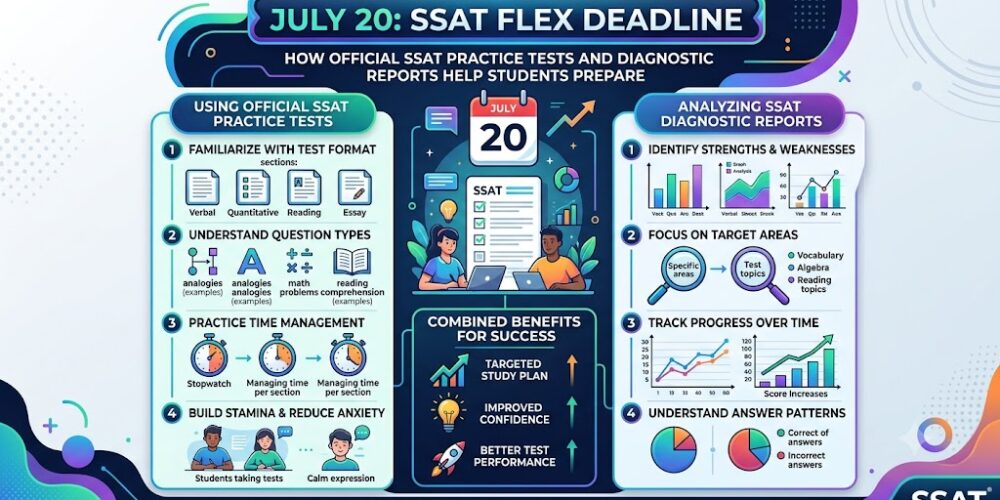
School is out, but for families planning to apply to independent schools, summer is one of the best times to prepare for the SSAT. With fewer classroom assignments and extracurricular activities, students can focus on improving their skills before the SSAT Flex registration deadline on July 20. Success comes from more than simply taking practice tests—it comes from understanding why questions were missed and building a focused improvement plan. Here is how leveraging official practice tests and in-depth diagnostic reports can help students maximize their prep time and walk into test day with confidence.
The Advantage of Official SSAT Practice Tests
When time is limited, the quality of your practice materials is just as important as the quantity of hours you put in. Official practice tests—created by the Enrollment Management Association (EMA) or their official partners—are the gold standard for test prep.
- Authentic Difficulty and Format: Third-party prep books often feature questions that are either artificially difficult or too simplistic. Official tests mirror the exact verbiage, trap answers, and logic of the real exam, ensuring there are no surprises on test day.
- Building Mental Endurance: The SSAT is a marathon, not a sprint. Taking full-length, official practice tests helps students build the stamina required to maintain focus through the final reading comprehension passages.
- Accurate Scoring Benchmarks: Because the SSAT uses a specific scaled scoring system with a negative marking penalty (losing 0.25 points for incorrect answers), practicing with official materials provides a realistic picture of where a student actually stands.
The Game-Changing Power of Diagnostic Reports
Taking practice tests is only half the battle; analyzing the results is where the actual score improvement happens. This is where diagnostic reports transition a student from guessing what they need to study to knowing exactly where to focus.
1. Pinpointing Error Patterns
A raw score tells you how many questions you missed, but a diagnostic report tells you why. Does the student struggle with vocabulary analogies or reading inference questions? Are they consistently missing algebra concepts while acing geometry? Identifying these micro-weaknesses allows students to drill high-yield topics rather than wasting time reviewing concepts they have already mastered.
2. Time Management Architecture
Pacing is one of the biggest hurdles on the SSAT. Diagnostic tools often highlight timing inefficiencies. For instance, a report might reveal that a student is spending three minutes overthinking medium-difficulty math problems, forcing them to rush and blindly guess on the last ten questions. Recognizing this allows students to practice the “Educated Guess” framework—skipping questions quickly if they cannot eliminate any answer choices, thereby protecting their raw score.
3. Tracking Section-by-Section Trends
Diagnostics separate performance into verbal, quantitative, and reading segments. This allows families to set realistic, targeted goals. If a student’s quantitative score is already in the 85th percentile but their reading score is lagging in the 50th, the final weeks of prep can be heavily skewed toward reading comprehension strategies, such as identifying the main idea before getting bogged down in details.
A Strategic Study Blueprint for the Final Weeks
With July 20 just around the corner, here is a streamlined plan of attack:
- Take a Baseline Test: Immediately take a full-length, official practice test under realistic conditions (timed, quiet room, no phone).
- Analyze the Diagnostics: Review the score report to identify the top three weak areas in both content and pacing.
- Targeted Drilling: Spend the next week doing focused practice solely on those identified weak spots.
- The Final Dress Rehearsal: Take one last official practice test a few days before the real exam to build confidence and finalize pacing strategies.
To learn the strategy to score higher download Socrato free ebook strategies-to-prepare-ssat-in-an-effective-way
With the July 20 SSAT Flex registration deadline approaching, now is an ideal time to take advantage of the quieter summer months and prepare strategically. Official SSAT practice tests provide the most realistic testing experience, while detailed diagnostic reports help students and tutors focus on the areas that matter most.
Whether you’re preparing independently or working with a tutor, combining an official practice test, an official bubble sheet, and meaningful performance analysis can transform practice into measurable progress. Platforms such as Socrato support that process by grading official SSAT bubble sheets and providing comprehensive diagnostics, allowing students to approach test day with greater confidence and a clearer plan for success.