
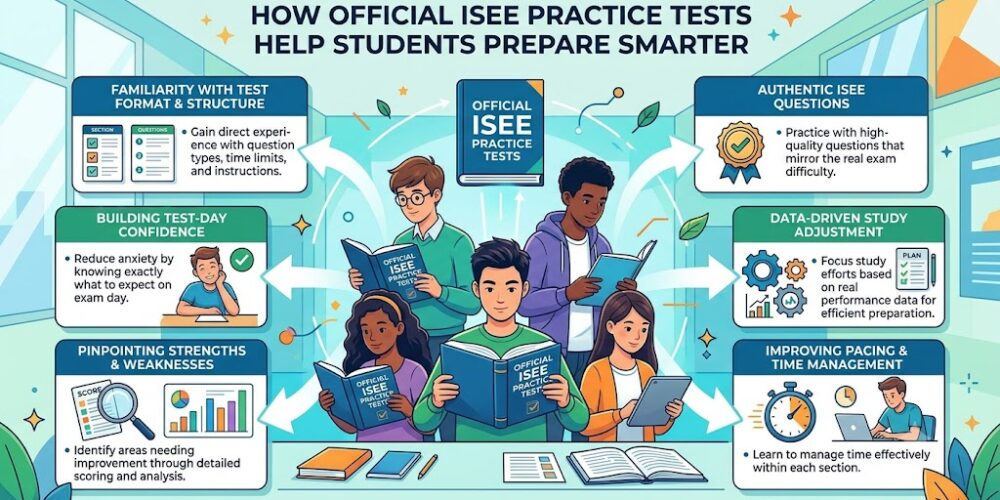
How Official ISEE Practice Tests Help Students Prepare Smarter
Why Tutoring Companies Should Start Every ISEE Preparation Program with an Official Practice Test
Preparing students for the Independent School Entrance Examination (ISEE) is about much more than teaching academic content. Successful ISEE preparation requires tutors to understand each student’s strengths, weaknesses, testing habits, and readiness level before building a study plan.
Yet many tutoring companies still begin their programs with a standard curriculum rather than a diagnostic assessment.
The result? Tutors often spend valuable instructional time teaching concepts students already understand while missing critical skill gaps that could significantly impact test-day performance.
This is why Official ISEE Practice Tests are one of the most valuable tools available to tutoring companies. They provide an accurate baseline of student performance, reveal hidden weaknesses, and help tutors create personalized preparation plans that maximize improvement.
When combined with detailed diagnostic reporting and performance analytics, official practice tests allow tutors to move beyond guesswork and make data-driven instructional decisions that help students prepare smarter—not simply harder.
What Makes an Official ISEE Practice Test Different?
Many students take unofficial assessments found online or included in generic test-prep books. While these resources can provide additional practice, they often fail to accurately replicate the structure, difficulty, pacing, and question styles of the actual ISEE.
Official ISEE Practice Tests are designed to mirror the real exam experience, providing students with exposure to:
- Authentic question formats
- Realistic testing conditions
- Official timing requirements
- Verbal Reasoning questions
- Quantitative Reasoning questions
- Reading Comprehension passages
- Mathematics Achievement content
- Essay prompts similar to those encountered on test day
This realism provides valuable insight into how students are likely to perform during the actual exam.
For many students, their first official practice test reveals challenges that are not evident through school grades alone. A straight-A student may struggle with pacing. A strong reader may have difficulty with inference questions. A student who excels in classroom math may struggle with quantitative reasoning concepts.
Only a comprehensive practice assessment can uncover these patterns.
The Biggest Mistake Tutoring Programs Make
One of the most common mistakes in ISEE preparation is assuming that all students need the same instruction.
A standardized curriculum may be easier to deliver, but it often fails to address the individual needs of each student.
Before instruction begins, tutors should understand:
- Which section requires the most improvement?
- Which skills are already mastered?
- Is timing affecting performance?
- Are careless mistakes reducing scores?
- Does the student struggle with vocabulary development?
- Are reading comprehension skills limiting performance?
- Are quantitative reasoning concepts creating difficulties?
An official practice test provides answers to these questions immediately.
Even more valuable is the ability to review category-level diagnostic data. Rather than simply seeing that a student scored lower in Reading Comprehension, tutors can identify whether the issue lies with inference questions, author’s purpose questions, supporting evidence questions, or time management.
This level of insight allows tutoring companies to build highly targeted preparation plans.
Why Diagnostic Reports Matter More Than Scores
Many parents focus primarily on the final score generated by a practice exam.
However, experienced tutors understand that the score itself is only the beginning.
The real value lies in understanding why the student earned that score.
Detailed diagnostic reports transform assessment results into actionable information by identifying performance patterns across individual skill areas.
Modern grading platforms can automatically generate diagnostic reports after an official practice test is completed, allowing tutors to spend less time scoring exams and more time analyzing results and planning instruction.
Instead of reviewing hundreds of answers manually, tutors can immediately identify trends and prioritize areas with the highest potential for improvement.
Identifying Verbal Reasoning Weaknesses
The Verbal Reasoning section is often one of the most challenging parts of the ISEE.
Students frequently struggle with:
- Vocabulary knowledge
- Synonyms
- Word relationships
- Context clues
- Analogical reasoning
A student may appear to have a strong vocabulary in school but still struggle with advanced ISEE-level terminology.
Diagnostic reports help tutors identify specific vocabulary weaknesses and create targeted vocabulary-building plans.
Instead of assigning broad vocabulary lists, tutors can focus on the precise categories causing difficulty.
This targeted approach improves efficiency and often produces faster results.
Improving Reading Comprehension Performance
Reading Comprehension is another area where detailed analysis can significantly improve tutoring effectiveness.
Many students and parents simply conclude that a student “needs help with reading.”
However, reading comprehension weaknesses are often far more specific.
Students may struggle with:
- Main idea questions
- Inference questions
- Supporting detail questions
- Author purpose questions
- Passage pacing
- Evidence-based reasoning
Detailed diagnostic reporting can reveal patterns that are difficult to detect through manual review alone.
For example, a student may consistently answer factual questions correctly while missing inference-based questions. Another student may demonstrate strong comprehension but run out of time before completing the section.
Once tutors identify the underlying issue, they can design interventions that directly address the problem.
Using Quantitative Reasoning Results to Guide Instruction
The Quantitative Reasoning section measures mathematical thinking rather than simply mathematical knowledge.
Many students find this section difficult because it requires problem-solving and logical reasoning skills.
Diagnostic analysis can help tutors identify weaknesses in areas such as:
- Number concepts
- Mathematical reasoning
- Algebraic thinking
- Geometry concepts
- Multi-step problem solving
- Quantitative comparisons
By understanding which reasoning skills need improvement, tutors can focus on developing critical thinking strategies rather than simply assigning additional math problems.
Understanding Mathematics Achievement Performance
Unlike Quantitative Reasoning, Mathematics Achievement focuses on learned mathematical content.
Students may struggle with:
- Fractions
- Ratios
- Decimals
- Algebra
- Geometry
- Data analysis
- Arithmetic accuracy
A detailed assessment report allows tutors to isolate individual content gaps and prioritize instruction accordingly.
This approach ensures that tutoring time is spent on the concepts most likely to improve student performance.
Building Personalized ISEE Study Plans
One of the greatest benefits of official practice tests is the ability to personalize preparation.
Consider three students:
Student A
Strong in Mathematics
Weak in Reading Comprehension
Recommended Focus:
- Reading passage analysis
- Inference questions
- Vocabulary development
- Reading pace strategies
Student B
Strong in Verbal Reasoning
Weak in Quantitative Reasoning
Recommended Focus:
- Mathematical reasoning
- Problem-solving frameworks
- Quantitative comparison questions
- Logic-based exercises
Student C
Strong Academically
Weak Time Management
Recommended Focus:
- Section pacing
- Test endurance
- Strategic guessing
- Timed practice sessions
Without diagnostic testing, all three students might receive similar instruction.
With diagnostic reporting, tutors can provide personalized support that addresses each student’s unique needs.
Tracking Progress Throughout the ISEE Preparation Process
Another major advantage of official practice testing is the ability to measure progress objectively.
Tutoring companies can establish:
- Baseline assessments
- Mid-program checkpoints
- Final readiness evaluations
When diagnostic reports are generated consistently across multiple assessments, tutors can track both score growth and skill development.
This allows students, parents, and tutors to see measurable progress throughout the preparation process.
It also creates opportunities to adjust study plans when necessary.
If a student’s Reading Comprehension skills improve while Quantitative Reasoning remains stagnant, tutors can shift instructional priorities accordingly.
Strengthening Parent Communication
Parents want to know whether tutoring is producing results.
Diagnostic reporting helps tutoring companies provide clear and meaningful updates.
Rather than offering general observations, tutors can share:
- Score improvements
- Skill growth trends
- Category-level performance data
- Areas requiring additional attention
- Readiness indicators for test day
This data-driven approach builds trust and demonstrates the value of the tutoring program.
Many tutoring centers find that detailed assessment reporting improves parent satisfaction and student retention.
Making Practice Test Administration More Efficient
Administering practice tests can be time-consuming, particularly when tutors must manually score exams and create reports.
Many tutoring organizations now use platforms that automate practice test grading and generate comprehensive diagnostic reports.
For example, after an official ISEE practice test is completed, tutors can receive detailed score analysis and performance breakdowns without spending hours reviewing answer sheets manually.
This allows educators to focus their efforts on interpreting results, coaching students, and developing personalized study plans rather than administrative tasks.
The combination of official practice tests, efficient grading workflows, and detailed diagnostics creates a more scalable and effective preparation process.
Why Data-Driven Tutoring Produces Better Outcomes
The strongest tutoring programs do not rely on assumptions.
They rely on evidence.
Official ISEE Practice Tests provide objective performance data, while diagnostic reports reveal the underlying skills that influence student success.
Together, they help tutors:
- Identify learning gaps
- Personalize instruction
- Monitor improvement
- Communicate effectively with families
- Improve student confidence
- Increase overall program effectiveness
When preparation is guided by meaningful assessment data, students spend more time working on the skills that matter most.
Final Thoughts
The most successful ISEE preparation programs begin with accurate diagnosis rather than assumptions.
Official ISEE Practice Tests provide a realistic measure of student readiness, while detailed diagnostic reporting transforms test results into actionable learning plans.
For tutoring companies, this approach leads to more efficient instruction, stronger student outcomes, improved parent communication, and measurable evidence of progress.
Whether practice tests are administered in a tutoring center, classroom, or independent learning environment, they become significantly more valuable when paired with tools that provide efficient grading, detailed score analysis, and meaningful performance insights.
When tutors have access to this level of information, they can focus on what matters most—helping students build confidence, strengthen skills, and achieve their best possible ISEE performance.