
SAT vs. ACT: Why Every Tutor Should Start with a Comparison Test
Every year, thousands of high school students ask the same question:
“Should I take the SAT or the ACT?”
For many students, this decision feels overwhelming. They hear conflicting advice from friends, parents, school counselors, and social media. Some assume the SAT is easier. Others believe the ACT is the better choice. The reality is that neither test is universally better—the best test is the one that aligns with a student’s strengths, learning style, and testing habits.
This is where tutors play a critical role.
Today’s most effective tutors do more than teach content. They help students make informed, data-driven decisions that maximize their chances of success.
In this article, we’ll explore practical strategies tutors can use to guide students toward the right exam and build a personalized test preparation plan.
Why Choosing the Right Test Matters
Both the SAT and ACT are accepted by virtually every college in the United States. Admissions offices generally view them equally.
However, the testing experience differs significantly.
The SAT rewards:
- Analytical reasoning
- Strategic problem-solving
- Careful reading and interpretation
- Comfort with adaptive testing
The ACT rewards:
- Speed and pacing
- Rapid decision-making
- Strong grammar fundamentals
- Quick math execution under pressure
A student who naturally excels on one exam may struggle on the other—even if their academic ability remains the same.
Choosing the wrong test can lead to:
- Months of inefficient preparation
- Lower confidence
- Slower score improvement
- Increased test anxiety
Helping students avoid this mistake is one of the highest-value services a tutor can provide.
Step 1: Stop Guessing and Start Measuring
One of the biggest mistakes students make is selecting a test based on assumptions.
Common reasons include:
- “My friends are taking the SAT.”
- “My school focuses on the SAT.”
- “My sibling took the ACT.”
- “I heard the ACT is easier.”
None of these are reliable indicators.
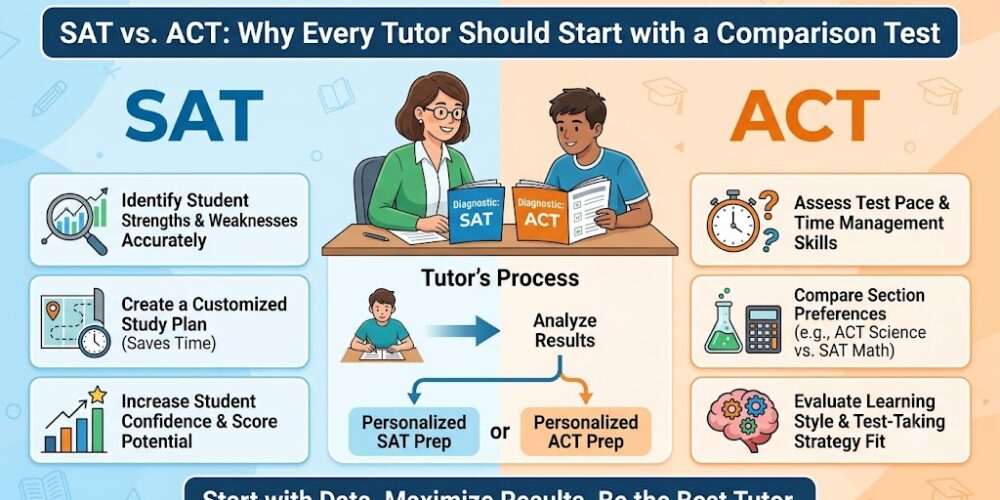
Instead, tutors should encourage students to experience both exams before committing to a preparation plan.
The goal is not simply to obtain scores.
The goal is to gather meaningful performance data.
Step 2: Have Students Experience Both Tests
There are several ways to compare the SAT and ACT.
Option 1: Take Full-Length Official Practice Tests
The traditional approach is straightforward:
- Complete one official SAT practice test
- Complete one official ACT practice test
- Compare scores, pacing, and overall comfort
This method provides valuable insight but requires significant time and effort.
Option 2: Use a Structured SAT vs. ACT Comparison Assessment
Many tutors now use specialized comparison assessments designed to evaluate a student’s fit for both exams in a single experience.
For example, the Socrato SAT vs. ACT Comparison Test provides students with a side-by-side evaluation of performance across both testing styles.
Rather than relying solely on raw scores, students receive detailed insights into:
- Timing performance
- Reading strengths
- Math proficiency
- Question-type performance
- Test-style compatibility
The result is a more informed decision before investing months in preparation.
Step 3: Look Beyond the Composite Score
One of the most valuable lessons tutors can teach students is that scores alone do not tell the entire story.
Consider two students:
Student A
- SAT Equivalent: Higher
- Struggles with pacing
- Makes careless mistakes late in the exam
Student B
- ACT Equivalent: Slightly Higher
- Strong timing control
- Consistent performance throughout sections
A simple score comparison might suggest one path.
A detailed diagnostic analysis often reveals a different story.
This is why modern tutoring increasingly relies on diagnostic reporting rather than score reporting alone.
Step 4: Use Diagnostics to Build Personalized Prep Plans
Once a student has completed a diagnostic assessment, the real work begins.
Strong diagnostics can reveal:
Content Gaps
- Algebra weaknesses
- Grammar deficiencies
- Reading comprehension challenges
Timing Issues
- Slow passage completion
- Difficulty finishing math sections
- Endurance breakdowns
Strategic Errors
- Question selection problems
- Inefficient pacing
- Poor guessing strategies
Platforms that provide detailed diagnostics allow tutors to quickly identify the highest-impact areas for improvement.
Instead of assigning generic homework, tutors can create customized preparation plans based on actual student performance.
Step 5: Turn Data Into Action
A diagnostic report should always lead to specific next steps.
For example:
If the Student Excels on SAT Reading
Action:
- Prioritize SAT preparation.
- Build advanced problem-solving strategies.
If the Student Thrives Under ACT Timing
Action:
- Focus on ACT-specific pacing techniques.
- Increase speed-based drills.
If Both Tests Are Close
Action:
- Examine diagnostic details.
- Consider student preference, schedule, and target colleges.
The key is moving from information to implementation.
Data only becomes valuable when it influences preparation decisions.
How Tutors Can Differentiate Their Services
Today’s families expect more than weekly tutoring sessions.
Parents increasingly want:
- Clear progress tracking
- Objective performance data
- Personalized recommendations
- Measurable results
Tutors who integrate diagnostics into their workflow gain a significant advantage.
Rather than saying:
“Your student is improving.”
They can show:
- Score growth trends
- Category-level improvement
- Timing progress
- Benchmark projections
Tools such as diagnostic reports and comparison assessments help create a more transparent and professional tutoring experience.
Advice for Academy Owners
For academy owners managing multiple students, the SAT vs. ACT decision becomes even more important.
A standardized comparison process can help:
- Place students into the appropriate programs
- Improve score outcomes
- Increase parent confidence
- Create more efficient tutoring pathways
Many academies now begin the enrollment process with a diagnostic assessment rather than immediately assigning students to SAT or ACT tracks.
This approach reduces guesswork and helps ensure students receive preparation aligned with their strengths.
Final Thoughts
Helping students choose between the SAT and ACT is no longer about intuition or tradition.
The most effective tutors rely on evidence.
Whether through official practice tests or comparison assessments such as the Socrato SAT vs. ACT Comparison Test, students benefit tremendously from experiencing both exams before committing to one.
The combination of comparative testing and detailed diagnostics allows tutors to make smarter recommendations, create more personalized study plans, and ultimately help students achieve stronger results.
The question is no longer:
“Which test is better?”
The better question is:
“Which test is better for this student?”
And the answer starts with data, diagnostics, and a thoughtful comparison process.