
June 13, 2026 ACT Countdown: How to Turn Practice Tests into Higher ACT Scores
The Final-Week ACT Preparation Guide for Students, Tutors, and Test Prep Centers: Use This Plan Now
The June 13 ACT is almost here.
At this stage, most students have already completed several ACT practice tests, reviewed countless questions, and spent weeks preparing for test day.
Now comes the most important question:
How do you use the final week to maximize your score?
Many students make the mistake of taking yet another full-length practice test every day leading up to the exam. Unfortunately, this often creates fatigue, increases anxiety, and leaves little time to learn from previous mistakes.
The final week before the ACT is not about learning entirely new content.
It’s about identifying the mistakes that are still costing you points and eliminating them before test day.
For both students and tutors, the most effective strategy is to use practice test data to drive focused review.
Stop Taking Tests. Start Analyzing Them.
A completed ACT practice test contains far more information than a composite score.
Every missed question tells a story.
Some mistakes come from content gaps. Others result from pacing issues, careless errors, or ineffective test-taking strategies.
The students who improve the most in the final week are often those who spend less time taking tests and more time analyzing them.
Ask yourself:
- Which question types do I consistently miss?
- Am I losing points because I don’t know the material?
- Am I making avoidable mistakes?
- Am I running out of time?
Answering these questions can often produce larger score gains than taking another practice exam.
Turn ACT Practice Tests into Actionable Diagnostic Reports
For tutors and students, one of the challenges of ACT preparation is converting raw test scores into a clear study plan.
A score report may tell you that a student earned a 27 composite score, but it doesn’t always explain where the biggest opportunities for improvement exist.
Detailed diagnostic reporting can help identify:
Knowledge Gaps
Questions were missed because a concept was not fully understood.
Examples include:
- Functions and graph interpretation
- Trigonometry
- Grammar and punctuation rules
- Scientific data interpretation
Execution Errors
Questions were missed despite understanding the content.
Examples include:
- Calculation mistakes
- Misreading the question
- Choosing a distractor answer
- Answer bubbling errors
Pacing Bottlenecks
Students often know how to solve questions but spend too much time doing so.
Diagnostic analysis can reveal:
- Time-consuming question types
- Sections where pacing breaks down
- Opportunities to improve efficiency
Many tutors use detailed diagnostic reports to create targeted study plans and communicate progress more effectively with families.
For example, services such as Socrato’s ACT bubble sheet grading and diagnostic reporting allow students and tutoring centers to upload completed ACT practice tests and receive detailed performance analysis. Rather than manually grading answer sheets and reviewing every missed question, tutors can quickly identify skill gaps, recurring error patterns, and high-impact areas for review during the final days before the ACT.
The goal isn’t simply to generate a score—it’s to transform practice test results into actionable insights.
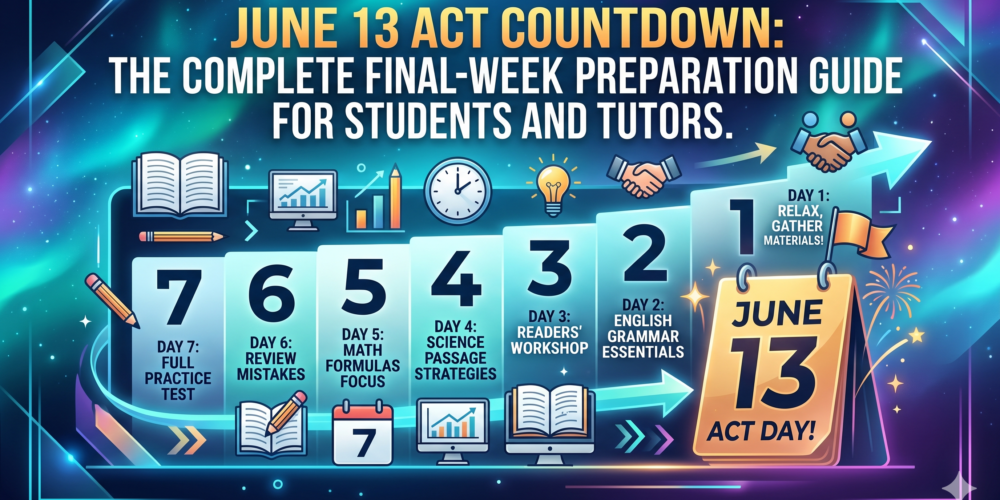
The June 13 ACT Final-Week Countdown
Monday & Tuesday: Review Your Biggest Point Leaks
Students
Avoid taking another full-length ACT practice test.
Instead:
- Review your most recent practice test.
- Create a list of recurring mistakes.
- Complete short timed drills in your weakest areas.
- Review every missed question until you understand exactly why the correct answer is correct.
Tutors
Conduct an error-analysis session.
Focus on:
- Recurring mistakes
- Timing issues
- Strategy breakdowns
- High-frequency ACT concepts
The objective is to eliminate preventable errors.
Wednesday: Lock Down Your Test Strategy
Students
Every section should have a clear game plan.
Ask yourself:
- Which Reading passage will I tackle first?
- What will I do if I get stuck on a difficult Math question?
- How will I approach Science graphs and charts?
Your strategy should be automatic by test day.
Tutors
Have students verbalize their plan.
If they cannot explain their strategy, they probably cannot execute it consistently under pressure.
Thursday: Light Review Only
Students
Spend no more than 60–90 minutes reviewing:
- Common grammar rules
- Frequently tested math formulas.
- Reading strategies
- Science data interpretation techniques
Avoid marathon study sessions.
Tutors
Focus on confidence-building rather than instruction.
At this stage, mindset often matters more than additional content review.
Friday: Rest, Recover, and Prepare
The day before the ACT is not a study day.
Research consistently shows that sleep, hydration, and stress management have a greater impact on next-day performance than last-minute cramming.
Pack your materials early and focus on recovery.
Section-Specific ACT Reminders
English: Trust the Simplest Correct Answer
The ACT often rewards concise, grammatically correct writing.
Pay special attention to:
- Commas
- Semicolons
- Apostrophes
- Sentence boundaries
- Redundancy
Math: Protect the Easy Points
Many students obsess over the hardest questions while making careless mistakes on easier ones.
Questions 1–30 are often where the biggest score gains can be found.
Reading: Evidence Wins
Every correct answer must be supported by the passage.
Avoid answers that require assumptions or outside knowledge.
Science: Let the Questions Guide You
The Science section is largely a test of data interpretation.
Focus on:
- Graphs
- Tables
- Experimental results
- Trends and relationships
Read only the information necessary to answer the question.
A Final Note for Tutors
Students often mirror their tutor’s emotional state.
During the final week, your role shifts from instructor to coach.
Keep communications calm, structured, and encouraging.
Help students focus on what they can control:
- Their preparation
- Their pacing
- Their mindset
- Their execution
A well-prepared student does not need more information in the final week—they need confidence.
Final Thoughts
The June 13 ACT is no longer about learning everything.
It’s about maximizing the value of the preparation you’ve already completed.
Use your ACT practice tests as diagnostic tools. Identify recurring mistakes. Focus on high-impact improvements. Refine your strategy. Prioritize rest.
Whether you’re a student preparing independently or a tutor guiding multiple students through test day, the final week should be driven by data, not anxiety.
The students who improve the most are often not the ones who study the longest—they’re the ones who learn the most from every practice test they’ve already taken. As the June 13 ACT approaches, trust your preparation, stay focused, and let your final review reflect the work you’ve already done.