
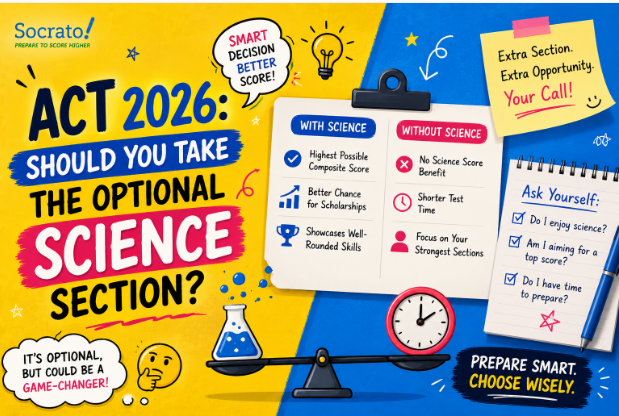
ACT 2026: Should You Take the Optional Science Section?
The ACT 2026 update (Enhanced ACT) brings one of the biggest changes in the test’s history:
The Science section is now optional.
For years, Science was a required part of your ACT composite score. Now, students must decide whether taking it actually adds value to their college application—or not.
ACT 2026 Scoring: What Changed?
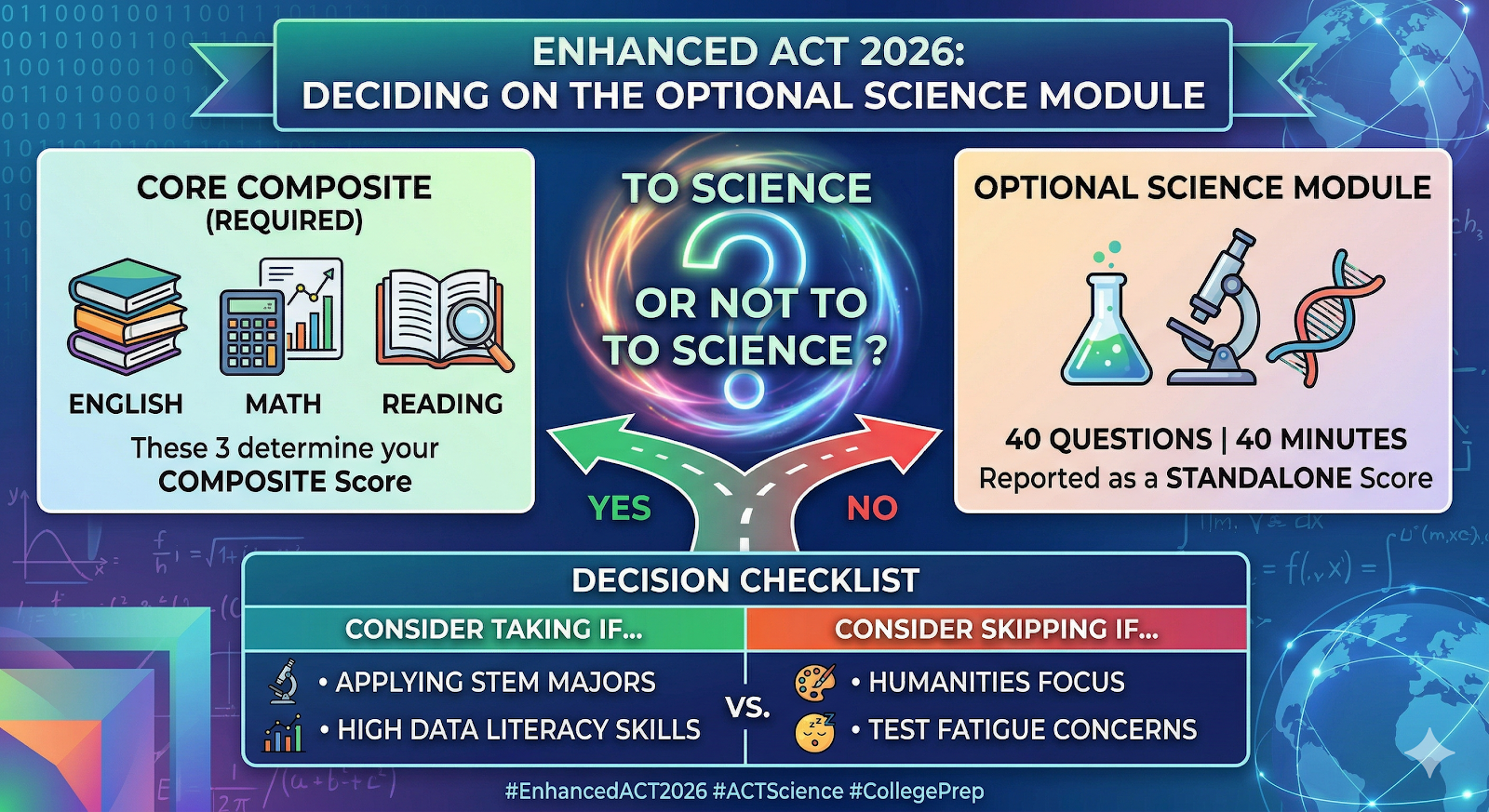
The new ACT composite score is based on just three sections:
- English
- Math
- Reading
Science is no longer included in the composite score.
If you take it, you’ll receive a separate Science score (1–36), similar to the optional Writing section.
What this means:
- Your core ACT score won’t be impacted by Science
- But colleges can still see and evaluate your Science score
Is ACT Science Really Optional?
“Optional” depends on how colleges interpret it.
Here’s how schools typically view it:
- STEM-focused colleges: Often require or strongly recommend Science
- Holistic colleges: Not required, but a strong score boosts your profile
- Test-optional/test-blind schools: Usually don’t consider it
If you’re applying for STEM (engineering, pre-med, tech), taking Science is highly recommended.
What’s on the ACT Science Section?
The ACT Science section tests data interpretation and reasoning—not memorization.
Format (2026):
- 40 questions
- 40 minutes
Question Types:
- Data Representation: Graphs, charts, trends
- Research Summaries: Experiments and variables
- Conflicting Viewpoints: Comparing scientific arguments
It’s more about logic and analysis than science knowledge.
Use the Socrato ACT diagnostic Report to get the depth of the ACT Science section
Should You Take ACT Science?
Take It If:
- You’re applying to STEM programs
- You score 28–36 in practice tests
- Your target colleges recommend it
- You want to strengthen your academic profile
? Skip It If:
- You’re applying to non-STEM majors
- Your colleges don’t require it
- You struggle with timing or pacing
- You want to maximize your core score
Time & Strategy
- Without Science: ~2 hours
- With Science: ~2 hours 40 minutes
That extra time can impact performance, especially under pressure.
The smartest approach: Take a diagnostic test with Science and evaluate your score.
- Scoring 30+ easily? ? Take it
- Struggling or losing time? ? Skip it
Final Takeaway
The ACT didn’t make Science less important—it made it strategic.
Optional = Opportunity
- For STEM students: a strong advantage
- For others: a flexible choice
- For high scorers: a differentiator