
“What Is a Good SSAT Score? Percentile Ranks Explained for Private School Admissions”
If you’re navigating the admissions process for competitive private schools, understanding your SSAT score report is not optional—it’s strategic. Among all the numbers presented, the percentile rank is the most influential metric in how admissions officers evaluate your performance.
This guide breaks down SSAT scoring with precision and shows you how to interpret percentile ranks to strengthen your private school applications.
What Is the SSAT?
The Secondary School Admission Test is a standardized test used by many independent and private schools to assess applicants in three core areas:
- Verbal
- Quantitative (Math)
- Reading Comprehension
Students receive scores for each section, along with a total score and—critically—a percentile rank.
SSAT Score Structure (Quick Breakdown)
Each section of the SSAT is scored on a scaled range depending on the level:
| Level | Section Score Range | Total Score Range |
| Elementary | 300–600 | 900–1800 |
| Middle | 440–710 | 1320–2130 |
| Upper | 500–800 | 1500–2400 |
But here’s the key insight:
Raw scores don’t drive admissions decisions—percentile ranks do.
What Is a Percentile Rank?
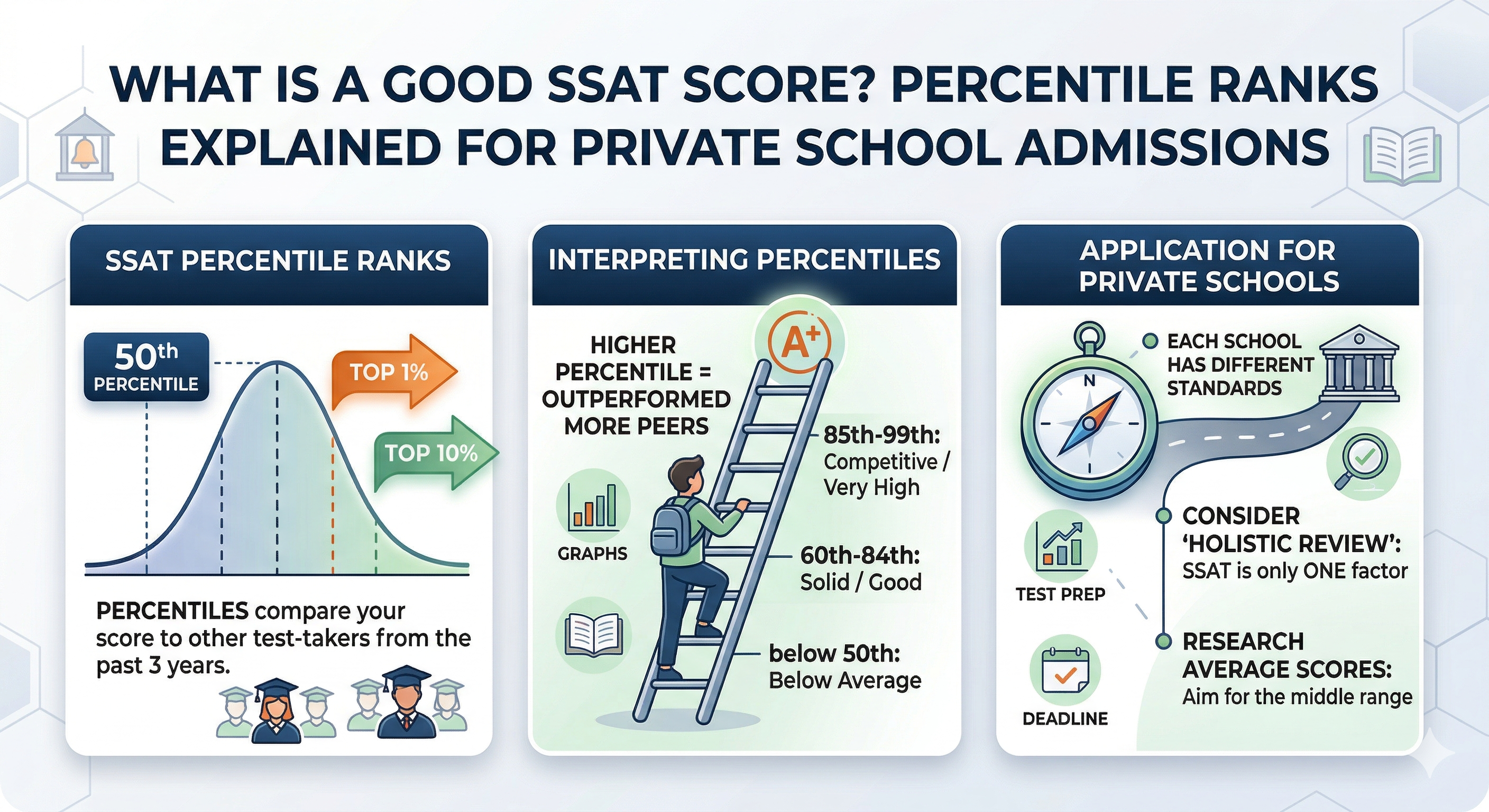
Your percentile rank tells you how you performed relative to other students in the same grade who took the SSAT.
- 90th percentile ? You scored better than 90% of test-takers
- 50th percentile ? You performed exactly at the median
- 25th percentile ? You outperformed 25% of students
Unlike scaled scores, percentiles provide context, which is exactly what admissions committees care about.
Why Percentile Rank Matters for Private Schools
Private schools don’t evaluate SSAT scores in isolation—they benchmark you against their applicant pool.
Here’s how percentile ranks are typically interpreted:
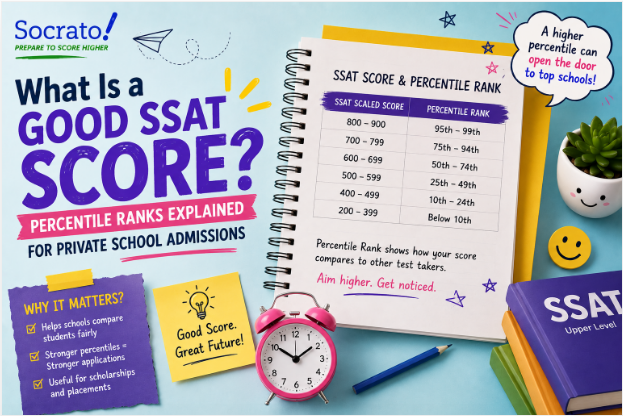
| Percentile Range | Admissions Signal |
| 90–99% | Highly competitive (top-tier schools) |
| 75–89% | Strong candidate |
| 50–74% | Average to above-average |
| Below 50% | Needs support from other application areas |
Important: Top-tier schools often expect 85th percentile and above, especially for Upper Level SSAT applicants.
The “Hidden Layer”: SSAT Percentiles vs National Percentiles
The SSAT provides a norm group percentile, which compares you to:
- Students in the same grade
- Students applying to private schools
This is not the general population.
Translation:Even a 50th percentile SSAT score represents a student already applying to competitive schools—making it more impressive than it appears.
Section Percentiles vs Overall Percentile
Your score report includes:
- Section percentiles (Verbal, Quantitative, Reading)
- Total percentile
Admissions officers analyze both.
Example:
- Verbal: 92nd percentile
- Reading: 88th percentile
- Quant: 65th percentile
Interpretation:
- Strong humanities profile
- Potential weakness in math
For academically rigorous schools, imbalanced scores can matter—especially if applying to STEM-focused programs.
How Admissions Officers Actually Use Percentiles
SSAT percentile is just one component of a holistic review process, which includes:
- Academic transcripts
- Teacher recommendations
- Personal essays
- Interviews
- Extracurricular achievements
However:
Important Percentiles often act as the first filter.
A low percentile may not disqualify you—but it raises the bar for the rest of your application.
What Is a “Good” SSAT Percentile?
This depends on the selectivity of the school:
Highly Selective Schools
- Target: 85th–95th percentile+
Mid-Tier Private Schools
- Target: 70th–85th percentile
Less Selective / Holistic Schools
- Target: 50th–70th percentile
Strategic takeaway:
Aim higher than the school’s average to stand out—not just qualify.
Common Mistakes Parents and Students Make
1. Over-focusing on Scaled Scores
A 2100 total score means little without percentile context.
2. Ignoring Section Imbalances
One weak section can impact admissions decisions.
3. Misinterpreting the 50th Percentile
This is not “average” in the general sense—it’s average among ambitious private school applicants.
4. Not Retaking the SSAT Strategically
SSAT allows multiple attempts—schools often consider the highest scores or view trends.
Should You Retake the SSAT?
You should strongly consider a retake if:
- Your percentile is below your target school’s range
- One section is significantly lower than others
- You underperformed due to test anxiety or timing issues
Even a 10–15 percentile increase can significantly improve admission chances.
Expert Strategy: How to Improve Your Percentile
If your goal is to move from, say, 65th ? 85th percentile:
- Focus on high-yield areas
- Vocabulary (Verbal section has exponential returns)
- Reading accuracy vs speed balance
- Analyze error patterns
- Concept gaps vs careless mistakes
- Simulate real test conditions
- Timed practice tests
- Section-level drills
- Use percentile-driven prep
- Benchmark your performance against target percentiles—not just raw scores
Final Takeaway
Understanding SSAT percentile rank isn’t just about reading a score report—it’s about positioning your application competitively.
Remember:
- Percentiles show where you stand
- Schools use them to filter and compare
- Strategic improvement can shift admissions outcomes
Want to Predict Your SSAT Competitiveness?
At Socrato, we help students go beyond scores with:
- SSAT percentile benchmarking tools
- Diagnostics of Official SSAT Practice test books Test.
- Free ebook to learn the Smart Strategy to achieve higher scores.
Know your percentile. Improve your positioning. Get into your target school.