
How to Maximize Your ACT Score for the 2026 Enhanced ACT Test Cycle
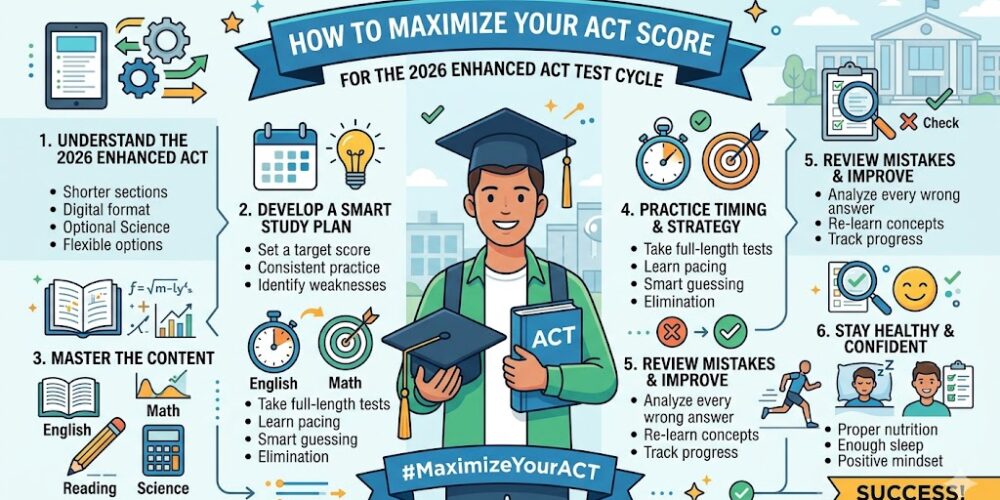
Preparing for the 2026 ACT test cycle requires a smarter, more strategic approach than ever before. With the transition to the Enhanced ACT format—featuring shorter sections, fewer questions, and more time per question—using outdated ACT prep materials can actually hurt your performance.
To achieve your highest possible score, your ACT test prep strategy must align precisely with the new exam structure. Here’s how to prepare effectively using official materials, realistic practice, and data-driven diagnostics.
1. Start with a 2026-Aligned ACT Diagnostic Test
Before beginning targeted ACT prep, take a full-length, 2026-aligned ACT diagnostic test. This establishes a reliable baseline and ensures your pacing and accuracy match the Enhanced ACT format.
What to Analyze in Your ACT Diagnostic
- Identify content gaps: Topics you haven’t mastered (e.g., grammar rules, algebra concepts).
- Spot strategy issues: Timing errors, rushed guesses, or avoidable “careless mistakes.”
- Adjust to new pacing: The Enhanced ACT provides approximately 22% more time per question. Use your diagnostic to determine whether you still feel rushed—or if you can shift your focus toward precision and accuracy.
A properly aligned diagnostic is the foundation of any high-scoring ACT preparation plan.
2. Use the Official ACT Prep Guide
The Official ACT Prep Guide 2025–2026 is the most reliable source for realistic practice and timing drills.
Why Official ACT Practice Tests Matter
- Authentic ACT questions written by the test makers
- Four full-length practice tests updated specifically for the Enhanced ACT
- Accurate section lengths, pacing, and question types
Avoid Using Pre-2025 ACT Tests
Older ACT practice tests include outdated formats, such as:
- 75 English questions instead of the new 50
- Incorrect timing ratios that disrupt internal pacing
Using outdated tests for timing practice can sabotage even the strongest content knowledge.
3. Simulate Real ACT Exam Conditions
To build endurance and confidence for test day, simulate official ACT test conditions during every full-length practice exam.
How to Practice Like Test Day
- Single sitting: Complete all core sections in one block (approximately two hours).
- Match your ACT format:
- Digital ACT ? practice on screen
- Paper ACT ? use printed tests and bubble sheets
- No formula sheets: The ACT does not provide math formulas. Memorize key geometry and trigonometry concepts in advance.
Realistic simulation is one of the most overlooked—but critical—elements of successful ACT prep.
4.Online Tool Diagnostics & Bubble Sheet Scoring
Practice alone doesn’t raise scores—diagnostics and analysis do. Online platforms like Socrato modernizes ACT prep by combining traditional practice with advanced performance analytics.
ACT Practice Test Diagnostic Report
Socrato’s Enhanced ACT–aligned diagnostic tests provide:
- Skill-level performance breakdowns
- Section-by-section accuracy and pacing insights
- Identification of recurring error patterns across tests
Bubble Sheet Scoring with Advanced Analytics
Socrato’s bubble sheet grading system transforms paper ACT practice into a data-rich experience:
- Instant scoring from scanned answer sheets
- Question-type and skill-area analysis
- Cross-test trend tracking to measure improvement over time
Students gain the comfort of paper ACT practice with the intelligence of digital diagnostics—without sacrificing realism.
5. Implement a Deep ACT Review Cycle
The biggest ACT score gains happen during review—not testing. Plan for at least two hours of review after every full-length practice exam.
High-Impact Review Strategies
- Maintain an ACT error log: Track missed questions, error type, and underlying concept.
- Review correct guesses: Confirm your reasoning to avoid relying on luck.
- Prioritize accuracy: With potentially stricter scoring curves for top scores (34–36), eliminating careless errors is critical.
Precision matters more than speed in the Enhanced ACT era.
6. Strategize for Optional ACT Sections
For the 2026 ACT, the Science section is optional and no longer included in the composite score.
How to Decide Whether to Practice ACT Science
- STEM / Pre-Med applicants: Continue ACT Science prep to showcase data analysis skills.
- Humanities-focused students: Consider skipping Science in full-length practice to conserve energy and sharpen core section performance.
Your ACT prep should align with both your college goals and testing strengths.
Final Thoughts: Smarter ACT Prep for the Enhanced ACT Era
The Enhanced ACT demands precision, alignment, and data-driven preparation. By using official 2026-aligned practice tests, realistic simulations, and tools like Socrato’s diagnostic testing and bubble sheet scoring, students can prepare with confidence—regardless of whether they choose the paper or digital ACT.
The right strategy doesn’t just prepare you for the test.
It prepares you to outperform it.